
How Much Does It Cost to Build a Social Media Platform like Threads?


Threads has been making significant noise since its launch, famously exceeding 100 million registrations in just five days. Today, the digital landscape has settled into a reality where Threads is no longer just an alternative but a dominant force, reaching over 450 million monthly active users. A key milestone in this evolution is the flip in mobile engagement: Threads has officially moved ahead of X in daily active mobile users, reaching 141.5 million.
This success raises a fundamental question: is it even worth building a platform based on an existing idea? The evolution of Meta’s ecosystem suggests that strategic "borrowing" is often the shortest path to market leadership. Just as Instagram successfully integrated Stories from Snapchat in 2016 and later countered TikTok with Reels, the rise of Threads follows a proven pattern. It’s not about simple cloning; it’s about taking a familiar format, enriching it with better algorithms, and scaling it through a superior infrastructure.
Do you also want to create a text-based ecosystem by implementing the best solutions of Threads and X while adding new features? You are on the right track. In this article, we will tell you what functionality needs to be included and how much it costs to build a cross-platform solution like Threads using modern engineering standards.
What Is Threads and Why Are Text-Based Platforms So Attractive to Invest in?
Threads has successfully transitioned from an Instagram add-on to a fully independent social ecosystem. While it was launched as a friendly space for communication, its evolution has been driven by a shift toward interest-based discovery. With projected annual revenue hitting 11.3 billion dollars, the platform has moved from an experimental project to a primary revenue driver for Meta. A major shift in the current market is the complete decoupling of Threads from Instagram. Users can now create standalone accounts without an Instagram profile, and the platform no longer relies on a one-to-one transfer of follower bases. Instead, the Interest Graph algorithm takes center stage, allowing new creators to gain massive reach based on content quality rather than existing followers.
In contrast to the early days of micro-blogging, the ecosystem has evolved into a sophisticated publishing environment. While the standard post remains concise at 500 characters, the introduction of the Text Attachment feature allows users to attach long-form text blocks of up to 10,000 characters. This enables creators and businesses to publish deep-dive articles directly within the app, turning it into a direct competitor for platforms like Substack and Medium.
Why Is It Profitable to Invest in Such Applications?
Investing in a text-priority platform offers a unique set of strategic advantages that are often overlooked in a video-dominated market. Focusing on the text format and prioritizing it over heavy media files significantly reduces initial development and infrastructure costs, allowing for a leaner MVP that can handle massive user concurrency without the astronomical server bills associated with video streaming. This approach also ensures maximum audience reach because text-based ecosystems are accessible to a global audience, including users with simpler devices or slower internet connections.
Furthermore, these platforms naturally focus on useful content such as news, deep-dive guides, and training materials, which leads to higher quality engagement and longer session times compared to the passive scrolling seen on visual platforms. From a business perspective, the format provides a clean slate for advanced monetization through sponsored long-form content, premium subscription models, and usage-based access for business accounts. Finally, since text is the native language of modern AI, this format provides incredible opportunities to use progressive technologies like NLP and RAG to deliver hyper-customized content, analyze user sentiment, and offer instant high-quality translations from day one.
Engineering Standards for Building a Threads Alternative
To compete in the current market, you should focus on specific technical benchmarks that ensure enterprise-grade performance and long-term scalability. These standards act as the functional backbone for a modern text-based ecosystem:
Latency First Infrastructure
Speed is the most critical factor for user retention. You should prioritize edge computing and WebSockets to ensure that the feed remains fluid and responsive across all devices, even during peak global traffic periods. When millions of users are reacting to a live event simultaneously, even a minor delay makes the platform feel disconnected. The goal is to make the interface update instantly as new data arrives.
Context-Aware RAG
Generic recommendation algorithms no longer meet user expectations. Using Retrieval-Augmented Generation (RAG) to power discovery engines ensures that suggested content is not just based on keywords, but is accurately mapped to the user’s current interests and real-time context. This technology allows the platform to understand the actual nuance of a discussion, connecting people with the most relevant threads immediately.
Deterministic AI Validation
Automated moderation is a necessity, but it must be predictable. You need to implement validation layers to ensure that moderation decisions are consistent, explainable, and compliant with regional regulations. This level of technical transparency helps maintain trust, as creators can see exactly why certain content was flagged or promoted, which prevents the frustration often caused by opaque practices.
Agentic Workflow Integration
Modern platforms are moving toward more autonomous management systems. You should build AI agents capable of handling complex tasks such as proactive threat detection, community management, and personalized content curation. These agents act as functional assistants that keep the ecosystem clean and relevant, allowing human teams to focus on high-level community strategy.
Fediverse Compatibility
The market now expects open connectivity. You must ensure the application is ready for the ActivityPub protocol, allowing users to interact across decentralized platforms without friction. By supporting the Fediverse, you are joining a global network of interconnected social spaces, which is a major requirement for users who value data portability.
Usage-Based Metering
As monetization strategies become more diverse, you need precise metering layers from the start. This allows you to track engagement accurately and support flexible revenue streams, whether it's usage-based pricing for business accounts or integrated tipping for creators. Having this infrastructure in place ensures that you can adjust the business model without rebuilding core billing logic.
SaaS Multi-Tenancy
If the platform targets enterprise partners or large organizations, strict data isolation is a baseline requirement. You need to implement robust multi-tenancy standards to manage multiple organizational environments safely. This ensures that corporate data remains separated across different tenants, meeting the high security and compliance standards expected by enterprise-level clients.
Automated Technical Debt Governance
Fast development cycles often lead to architectural issues that become expensive later. You should utilize automated tools to monitor and manage technical debt starting from the first day of development. This governance ensures that the engineering team maintains high code quality, making it much easier to add new features or scale the infrastructure in the future.
Real-Time Data Pipelines
A text-based platform depends entirely on the speed of its data delivery. You need to set up event-driven architectures and robust data pipelines for instant content synchronization. This ensures that every like, repost, and reply is updated across the globe in milliseconds. Without this level of engineering, the conversation feels fragmented and the real-time nature of the platform is lost.
Zero Trust Security
Standard passwords and simple firewalls are no longer sufficient for a major social platform. You should integrate biometric authentication and end-to-end encryption as baseline standards for all user communications. Implementing a Zero Trust architecture means that every access request is continuously verified, protecting user privacy and safeguarding the platform against data breaches.
Essential Features for a Modern Social Ecosystem
If you want to build a successful platform today, pay attention to these core features that drive user engagement:
Standalone Identity Management
Move beyond simple social logins. Implement robust Identity as a Service (IDaaS) that allows for independent account creation while still offering optional cross-platform syncing.
Interest-Based Discovery
Instead of relying on follower counts, implement an algorithm that surfaces content based on engagement patterns. This "TikTok for Text" approach is what drives growth in modern social apps.
Advanced Messaging
Modern Messaging now allows for seamless sharing of high-res media and the new 10,000-character attachments, turning the platform into a professional communication tool.
Familiar yet Enhanced Interface
Utilize familiar "Like," "Repost," and "Quote" options to eliminate the learning curve, but enhance them with AI-driven summaries and sentiment analysis.
Dynamic Communities
Enable users to gather in groups and join topic-related communities. This fosters loyal follower bases and encourages deep, meaningful discussions.
AI-Powered Conversation Control
Use AI agents to handle real-time moderation, filtering out noise while ensuring a safe atmosphere for all users.
Factors Affecting the Development Cost
The cost of developing an application depends on many factors. The project budget is affected by the platform, the complexity of the solution, the location and size of the team, design features, etc.
UI/UX Design
High-quality UI/UX is the foundation of user retention. In today's market, this involves complex interaction design, accessibility standards, and dark mode optimization. Custom animations and interactive elements require more time from senior designers and front-end developers, impacting the cost.
Multi-Platform Reach
While native development for iOS and Android separately offers maximum performance, it is the most expensive route. Most modern startups opt for cross-platform frameworks like Flutter, which allow for a single codebase. However, you must also account for a robust web version to cater to desktop users and professional creators.
Team Size
The complexity of your roadmap dictates the size of your team. A full-scale Threads alternative needs specialized roles: DevOps, QA engineers, backend architects, and AI specialists. Your choice of engagement model, whether it's an in-house team or an outsourced dedicated team, will be the biggest line item in your budget.
Data Encryption
A text-based app like Threads stores user data. And your task is to protect it from unauthorized access and employment by third parties. The introduction of reliable data encryption mechanisms is necessary, leading to increased development costs.
Authentication and Authorization
Two-factor or even biometric (voice, fingerprint, or face id) authentication is another reliable way to safeguard user data. This requires additional skill and time to create, affecting the overall project budget.
Location of App Development Agency
The location of the development agency greatly influences the price of the application but says nothing about its quality. It all depends on the cost of living and the demand for specialist qualifications. Therefore, the budget for cooperation with a team from Europe will be much lower than in the US. Integrio is a Vancouver and Toronto-based software development company with development capacity not only in Canada but also in Europe. It means we can help you develop a top-notch media app or platform for lower prices.
Based on current benchmarks (average annual rates for senior developers in USD):
India: $18,000 – $25,000
Ukraine: $65,000 – $85,000
Germany: $95,000 – $115,000
Australia: $90,000 – $110,000
USA: $145,000 – $180,000
Canada: $110,000 – $135,000
Maintenance
Always consider the budget for maintaining your application, as its success in the long term depends on it. This includes diagnosing bugs, optimizing performance, and creating new features. As a rule, it takes 10-20% per year from the cost of the platform.
Tech Stack
By choosing a technology stack, you influence the duration of development and its cost. Many frameworks and libraries are open source, so you only pay for the experts' time. But using the latest technology may require a license or subscription (as well as hiring more experienced developers). That's why it's important to find a good team that can offer the best stack for your needs and resources.
Features
The number and complexity of features can inflate your development budget. It is important to find a balance where you provide the most important functionality and stand out from the competition, but do not overload the application. Still, for startups, it's better to start with an MVP and then work out user feedback by adding new options.
How to Build a Platform Like Threads?
Requirement Analysis
Start by clearly defining the platform's purpose and core functionality. In addition to text threads and long-form attachments, clarify the target audience, monetization methods, and regional compliance.
Market Research
Explore the market to analyze the current situation, demand, and user preferences. Study the offers of Threads and X to find gaps. This research must also include analyzing the impact of decentralized protocols like ActivityPub.
Technical Architecture
Define the technology stack and infrastructure. It is important to ensure software scalability and performance under heavy load, including the architecture of RAG pipelines and AI agent workflows.
Development (Frontend & Backend)
Build the client side of the application (mobile and web), bringing UI/UX design to life. Simultaneously, set up the server infrastructure, including vector databases for AI-driven discovery.
Testing and Quality Assurance
Thorough testing before release will help avoid reputational losses. Let QA specialists identify all bugs and glitches, ensuring that AI validation layers provide consistent and accurate results.
Deployment and Maintenance
After all improvements, publish the application in stores and launch the web version. Regularly monitor performance to gather ideas for updates. Don’t forget that maintenance typically requires 10–20% per year of the initial cost.
Tech Stack to Develop Apps like Threads
The right choice of technical stack helps you optimize the development time and budget, as well as guarantee the necessary functionality. To build an application like Threads, you can consider the following technologies:
Mobile Development: Flutter (cross-platform), Swift (iOS), Kotlin (Android)
Web Development: React.js or Next.js
Backend Infrastructure: Node.js, Go (for high-concurrency microservices)
Database Systems: PostgreSQL, MongoDB, Pinecone (vector database for RAG)
AI & Machine Learning: LangChain (for agentic workflows), OpenAI API or local Llama 3 models
Real-time Communication: WebSockets (Socket.io)
Data Streaming: Apache Kafka
DevOps: Docker, Kubernetes, Terraform
Exploring the Development Cost
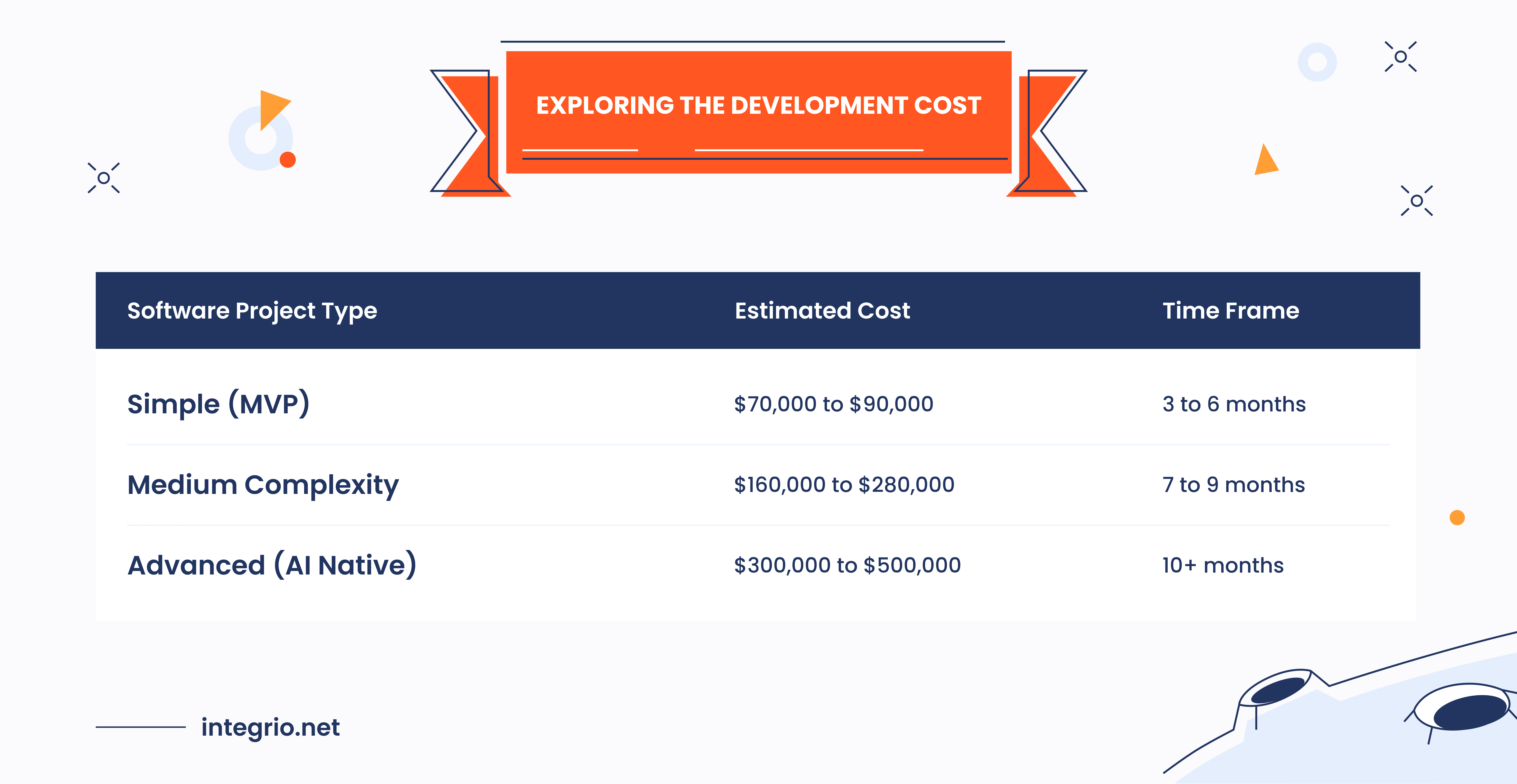
The cost of developing a social platform depends on many factors, including complexity and the location of the team. In general, the price today ranges from 40,000 to 300,000 dollars:
Create Your Own Threads with Integrio
The success of Threads in 2026 proves that the market still has a massive appetite for stable and well-structured social platforms. Building a product of this scale offers immense monetization potential through targeted ads, premium subscriptions, or integrated e-commerce. However, entering this space requires a strategic investment. Depending on the complexity of the features and the location of your development team, the initial costs typically range from $70,000 to $500,000.
Integrio can become your strategic development partner to help you navigate these technical requirements. We work with you to select the right technology stack and an optimal feature set that fits your specific budget. Our team ensures that your application is built on a scalable infrastructure that can handle rapid user growth from day one. Contact us today to discuss your vision and start building a platform that meets the modern standards of digital conversation. You can also meet with us in one of the Canadian locations, for example, in our Vancouver or Toronto offices, or in the city centre locations.
FAQ
The development timeline for a social media platform is dictated by the depth of its feature set and the engineering standards applied. Creating a basic text-based platform typically takes about 3-6 months. For a medium-complexity system with standard social features and cross-platform compatibility (iOS, Android, and Web), the timeline extends to 7-9 months. Developing an advanced ecosystem with sophisticated recommendation algorithms and Fediverse compatibility generally requires ten months or more.
Contact us
