One of the core strengths of custom software development projects is their flexibility, and that’s reflected in the sheer variety of reasons companies build their own solutions. For some, it’s to create automation systems that streamline their workflows. Others use custom solutions to connect different software and establish an internal network of tools. Then there’s the use of custom development to create unique, monetizable products.
But, regardless of the purpose this software will serve, most businesses begin their planning with one simple question: What is the cost of custom software development? Today’s article aims to answer that question with information on typical price ranges and what those budgets cover. We will cover several types of projects, including web and SaaS, and advise on managing costs, too. Let’s get started.
Factors That Affect Custom Software Development Cost
Your software development price will be influenced by a typical range of factors that affect pretty much any such project, including:
Scope and feature richness;
Architectural complexity;
Integrations;
Desired level of scalability;
Resilience requirements.
The trick here is that these factors are interconnected: a larger scope attracts more users, which in turn requires extra scalability down the line. That, in turn, necessitates complex architecture that guarantees the software’s stability. Basically, if you want one of these to be above average, the rest will have to be as well. However, even with a simple product, certain factors increase the final cost.
What Increases Custom Software Development Costs
As work gets underway, you may encounter a few typical expense-causing moments, most of which are tied to product quality. For example, if your software must be compatible with many external systems, you’ll have to invest more. Though remember that this kind of thing may be completely impossible with an off-the-shelf solution, so the cost is typically worth it.
Next, those seeking to include AI models and real-time analytics in their software will also have to expect a higher bill. These trendy features are popular for a reason, but high demand and a requirement for specific skills make them pricey. Basically, any kind of complicated data pipeline setup does the same.
Lastly, depending on your industry, you may need to beef up your security and compliance, as well as bake in the expense of possible new legislation down the line. This is particularly relevant for healthcare and manufacturing fields.
Leading Countries in the Custom Software Development Market
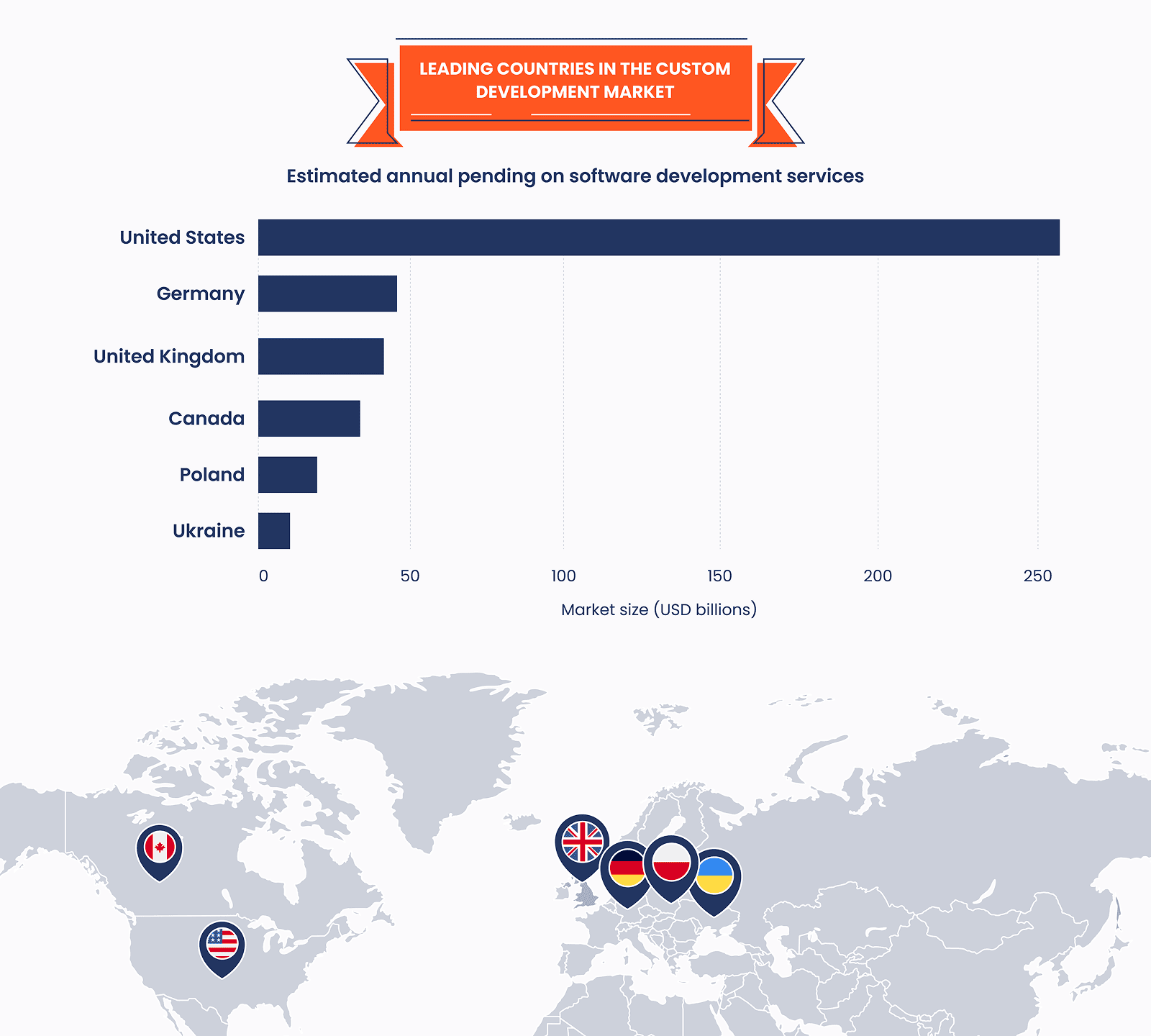
Team location is quite important when it comes to the software development costs, as certain locations have overall higher rates, usually owing to both the cost of living and the quality of talent. A good way to assess whether a specific country or region is worth looking at is to contrast its typical rates with the market size and the eagerness of clients to pay these devs.
As we can see from the graph, the US is predictably first, along with the rather expensive Germany and the UK. But the more interesting part is the other three, as Canada boasts a large, diverse talent pool with favorable software development rates. Meanwhile, Poland and Ukraine are classic outsourcing destinations, offering a mix of affordable talent and experienced teams.
What Different Types of Custom Software Usually Cost
Now we can run down the list of software development project types and estimate their average budgets.
Cost of Developing Internal Business Tools
Many businesses rely on unique software to automate or optimize their operations, requiring key functions like:
Administrative dashboards;
Instant reporting;
Performance tracking;
Employee management;
Knowledge bases for onboarding and processing.
Typical price range: $35,000 – $150,000.
Cost of Custom Web Application Development
When it comes to web development, costs can vary widely depending on how complex the project is, what user roles it must include, and whether it will be integrated with other services. Thus, a simple MVP may cost even less than $25,000 while the most intricate products could cost up to $200,000, but those are still outliers from the typical range.
In terms of functionality, web solutions usually represent the following use cases:
Booking systems;
Marketplaces;
Operational management platforms;
Online service platforms.
Typical price range: $25,000 – $100,000.
Cost of Mobile Application Development
For mobile products, the budget is determined by your platform choice (iOS, Android, or both) and the integrations you want to include for backend processing. The last factor can be a substantial influence as mobile projects include starkly different ideas, such as:
Marketplace apps;
Subscription-based services;
Delivery management;
Employee-facing apps.
Typical price range: $40,000 – $100,000.
Cost of SaaS Platform Development (MVP)
The development process is more complex than mobile or web products, resulting in a higher upper price point. This is due to their inclusion of subscription management, varied user roles, and scalability potential. Your final budget is determined by how ambitious the project is and how technologically refined it is. Common SaaS development directions:
Project management;
Workflow automation;
CRM platforms;
Collaboration;
Niche industry operations.
Typical price range: $20,000 – $160,000.
Cost of Inventory Management Software Development
Aside from longer development timelines on average, inventory tool costs vary by operational volume support, ERP, and accounting software integrations, and analytical capabilities. Thus, the average price is steep, but you do get a variety of uses, such as:
Warehouse inventory systems;
Stock tracking platforms
Multi-location inventory;
Supply chain tools;
Inventory analytics dashboards.
Typical price range: $40,000 – $120,000.
Cost of Custom ERP Software Development
ERP systems tend to be more expensive because they require a software development team with industry-oriented skills, as well as more intricate backend work. Things like interwoven workflows, dozens of modules, and legacy system integrations are par for the course. This category includes:
Planning of enterprise resources;
Operations management;
Financial management systems;
Workforce management;
Production planning.
Typical price range: $120,000 – $350,000+.
Cost of Logistics Software Development
Catering to a specific niche, logistics tools often require unique skill sets to deliver features such as real-time mapping, vehicle tracking, and instant analytics. These pricey solutions are, however, indispensable and include systems for:
Transportation management;
Fleet management;
Route optimization;
Shipment tracking;
Operational control.
Typical price range: $150,000 – $400,000+.
Cost of Data Analytics Software Development
Analytical tools can reach a fairly broad scale depending on how many data streams they integrate, what processing they perform on the data, and how intricate their reporting and visualization are. As a result, this software can be expensive depending on which niche it takes:
Business intelligence dashboards;
Operational analytics platforms;
Customer analytics systems;
Financial analytics platforms;
Reporting dashboards.
Typical price range: $80,000 – $200,000.
Cost of AI and Machine Learning Software Development
When it comes to custom software, cost is a major variable that can change even during development, especially when working with popular technology like AI. ML- and AI-based projects may demand pivots and extra resources to clean up data, train the model, and integrate AI into your ecosystem. The payoff, though, is the huge variety in functionality that keeps AI-centric products useful in any industry:
Demand forecasting;
Recommendation engines;
Predictive analytics;
Fraud detection;
Computer vision.
Typical price range: $60,000 – $300,000+.
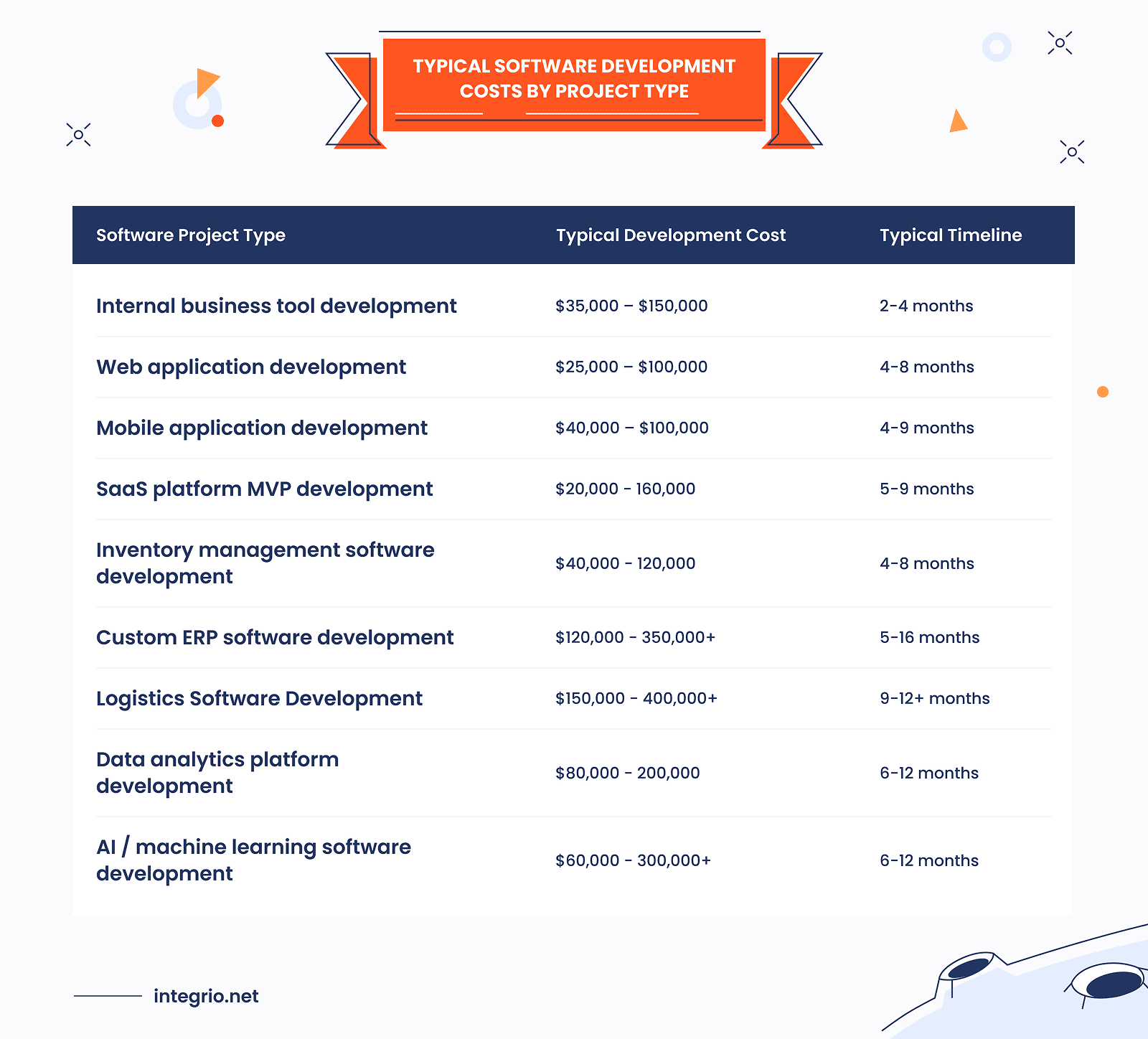
Software Development Costs by Project Type
When you hire a software development company, there are some predictable expenses and some hidden costs. While we obviously can’t anticipate all the hidden ones, we can help estimate the general budget.
How Businesses Can Keep Software Development Costs Under Control
The best way to mitigate the custom software development cost is to prevent scope creep by clearly planning the project's details. Even if you want the product to be ambitious and feature-rich, begin with a simple foundation, just an MVP that validates your ideas. That way, you put core features first and stick to the original plan. We’d also recommend reusing existing widgets and tools to both speed up development and simplify the workload.
When Custom Software Development Becomes a Strategic Investment
A high upfront cost does not always mean poor value. If custom software supports a core business function, it can deliver a strong return on investment over time. The payoff may come through efficiency gains, improved service delivery, or new revenue streams. That is often the case with SaaS products, customer-facing web and mobile apps, automation tools, integration platforms, and digital products that help a business scale.
Conclusion
Now that you know what custom software development pricing looks like, you can create a detailed project outline to ensure the work goes smoothly and keeps expenses down. Using the tips we provided, you should have a firm grip on your budget and be able to control it fully. However, you now need to pick a solid partner to handle the development for you. Thankfully, Integrio Systems has that part covered as well.
Our Canadian software development firm has been in the market for 25+ years, with a portfolio of successful collaborations spanning SaaS platforms and mobile apps. Whether you need a full-stack team or just some developers for staff enhancement, reach out, and we’ll provide.
FAQ
As the work progresses, you may encounter project scope creep and obstacles that slow it down. This can increase the final budget. However, you might also find that development is going more smoothly than expected, cutting expenses accordingly.
Budgets typically include the rates you pay to your development partner, any relevant licensing fees, infrastructure costs, and maintenance fees.
For an accurate cost estimate, the dev team needs to understand the scope and goals of the work, the approximate architecture, and the timeline. These are all vital factors for not just listing the budget but planning the project stages and setting KPIs.
Delivering an initial build is much faster than a finished product, of course, but the actual timeline depends on how complex your project is. At minimum, we’d estimate a month, and that could go as high as 7 or 8 months.
In most cases, yes, as the budget is heavily influenced by the location of the development team and the process of assembling the actual team. Taking the standard in-house development approach ends up costing much more than outsourcing at a fast pace.
We use cookies and other tracking technologies to improve your browsing experience on our website. By browsing our website, you consent to our use of cookies and other tracking technologies.