
Context Engineering for LLMs: Why You Need It as Much as LLM Prompt Engineering


When LLMs went mainstream, they quickly hit a key limitation: context. Yes, LLMs can answer questions, rewrite code, and sum up lengthy documents. But they could just as easily “forget” what they said earlier in the thread or struggle to parse a long Slack conversation.
The thing is, by default, LLMs are like goldfish. Their memory is limited and short — compared to humans’, at least.
That’s why prompt engineering emerged: you had to keep your instructions focused and precise so that the “goldfish” has all the information it needs to do what you want it to. But contrary to some AI researchers’ predictions, it didn’t become obsolete as LLMs got more sophisticated.
Instead, it evolved. It became context engineering.
Discover what it is, how it works, why you need it, and how to implement it from our context engineering guide.
What Is Context Engineering?
Every LLM has what’s known as the AI context window: the kind of working memory that the model uses to generate a response. That can include the prompt itself, the conversation history, real-time data, external sources (files, web pages), or system instructions.
Context engineering is the ensemble of practices you can use to manage and optimize that context window. Those practices, in turn, help make responses more specific, consistent, accurate, and personalized.
With the context engineering definition out of the way, let’s address a common misconception: context engineering is not the same as prompt engineering.
Here’s your primer on key context engineering vs prompt engineering differences:
| Prompt engineering | Context engineering | |
|---|---|---|
| Focus | Optimizing individual prompts (i.e., how requests are phrased) | Defining, managing, and optimizing what the model “knows” when generating a response |
| Scope | Individual interactions, in the moment | All interactions across the model, long-term |
| Key artifact | Prompt template library | Context layer |
| Impact | Response quality | System-wide performance |
| Context provision | Manual (written into the prompt by developers) | Automated and dynamic (pulled from databases, APIs, etc.) |
| Scalability | Each use case requires a new hand-tuned prompt | Creates institutional memory that scales across use cases |
Today, context engineering matters more than prompt engineering or even model choice. That’s because, without properly engineered context, the model simply can’t produce the output users expect. The result? Irrelevant or generic answers — and inconsistent behavior over time.
Why Prompt Engineering Alone Is Not Enough
As you can see from our brief prompt vs context engineering comparison, focusing only on prompts means working around several limitations:
- Prompts focus on phrasing and “hardcoded” instructions. So, models miss out on other contextual cues and dynamic information like real-time metrics or order history.
- Maintaining dozens or hundreds of prompts at the enterprise scale quickly becomes unsustainable.
- Prompt engineering impacts instructions within a single model call, so it doesn’t scale across use cases.
Prompt engineering was enough in 2022/2023, when context windows were small (~4,000 tokens). But it’s not enough in 2026 — and 82% of IT and data leaders recognize it.
Ultimately, context engineering is what separates production-ready AI agents from demos. Without context engineering, large language models can’t access dynamic context. For example:
| Without context | With context | |
|---|---|---|
| What the user types | “Recommend the next best action for this customer.” | “Recommend the next best action for this customer.” |
| What the LLM considers | The prompt + training data + system instructions | The prompt + training data + system instructions + the customer’s recent purchases, support history, current subscription plan, previous interactions, account status |
| What the model returns | A generic recommendation based on what similar customers may prefer | A concrete action based on this customer’s exact profile and predicted needs |
Key Components of Context Engineering
Just like humans, LLMs can have semantic, episodic, and procedural memory:
- Semantic. General knowledge and facts models can reference; comes from training or external knowledge bases, databases, or document stores.
- Episodic. Specific experiences, like past interactions and responses; enables the model to refer to earlier parts of the conversation.
- Procedural. System instructions and learned procedures that define the output (e.g., “always respond with lists”).
LLM memory management is a big part of managing context. That said, context goes beyond what’s stored in memory. For example, it can include:
- System instructions. These are the model’s internal rules for structuring input and output.
- External knowledge. These are all the facts and figures the model retrieves from other sources; it usually involves adding a RAG layer (more on it later).
- Tools and APIs. Modern systems can call on external tools and APIs to get up-to-date information from other systems (CRMs, ERPs) or perform actions before an LLM call.
- Conversation history. It enables the model to refer to earlier messages in the current conversation (short-term memory).
- User preferences. These are long-term likes and dislikes for each user, accumulated over time and stored in the long-term memory.
- Permissions and runtime context. Things like the user’s location or time can help personalize responses, while permissions define what the model can and can’t do.
Context engineering techniques help make context as effective as possible — without overloading the system in the process. Broadly speaking, there are three types of techniques for managing context:
| Type | Context engineering frameworks | Definition |
|---|---|---|
| Token optimization | Dynamic pruning | Removing less relevant information when approaching token limits using relevance scoring |
| Token optimization | Hierarchical summarization | Creating multi-level summaries for older interactions to preserve long-term continuity |
| Token optimization | Context compression | Compressing lengthy context into concise representations |
| Prioritization frameworks | Context importance scoring | Ranking context components based on their relevance to current tasks |
| Prioritization frameworks | User-centric prioritization | Ranking context components based on user preferences and interaction patterns |
| Prioritization frameworks | Task-adaptive context | Ranking context components based on the current task |
| Real-time management | Sliding window techniques | Keeping a dynamic context window that continuously changes based on the conversation flow and user needs |
| Real-time management | Predictive context loading | Anticipating context needs based on behavioral cues and pre-loading relevant information |
| Real-time management | Context swapping | Swapping context configurations based on shifts in the interaction mode or conversation flow |
Need an LLM that delivers specific, context-aware answers?

Retrieval-Augmented Generation Explained: How It Fits into Context Engineering
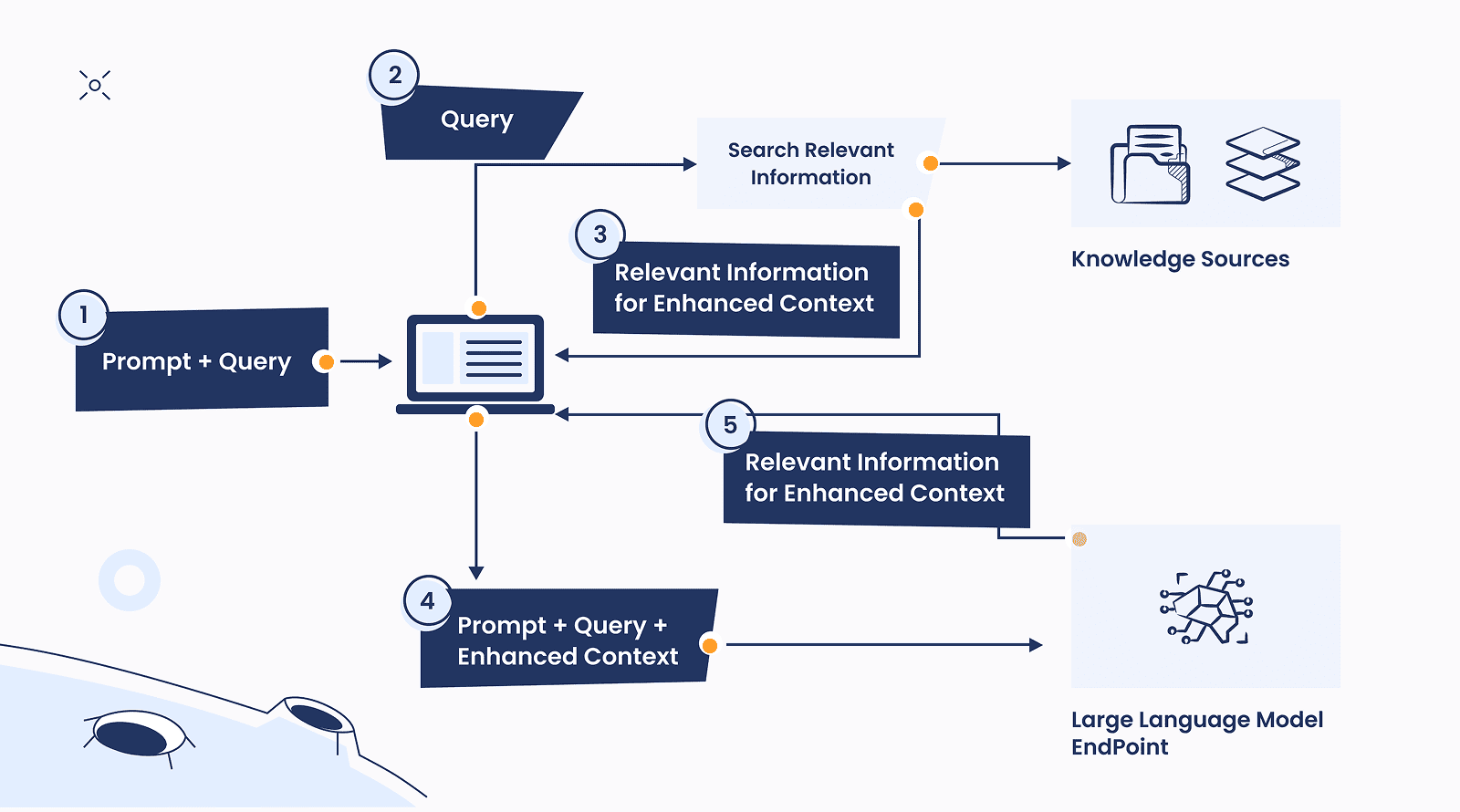
Much like prompt engineering, RAG is but a part of context management — although it’s an important one, nonetheless. RAG, or retrieval-augmented generation, is the how of getting an LLM to use knowledge from external sources.
Pioneered at Meta, this approach was a game-changer for one simple reason: it enables the model to use external knowledge without retraining it. Instead, the system simply pulls relevant information before sending the prompt and context to the LLM to generate the response.
Here’s a sample RAG architecture LLM applications can use:
RAG is extremely useful if:
- You need the LLM to reference the company’s policies, knowledge bases, or internal documents
- You want the LLM to access up-to-date information, without training cutoffs
- You need domain-specific responses that rely on a body of academic research or other “ground-truth” sources
- You want your LLM to cite sources behind its responses
However, RAG has its limitations. Vector embedding models used in RAG have a mathematical ceiling, for one. Hit it, and the model will collapse. (At 512 dimensions, the threshold is around 500K documents.) Besides, if the system retrieves the wrong thing — an outdated piece of data, an irrelevant document — the answer will also be wrong.
That’s why retrieval quality and relevance matter: if the system retrieves the wrong chunks just because keywords matched, the LLM will generate a nonsensical response.
As for the context engineering vs RAG differences, it’s a similar story to prompt engineering. RAG was there before context became the headliner, and it has a narrower scope: knowledge retrieval only.
LLM Pipeline Architecture
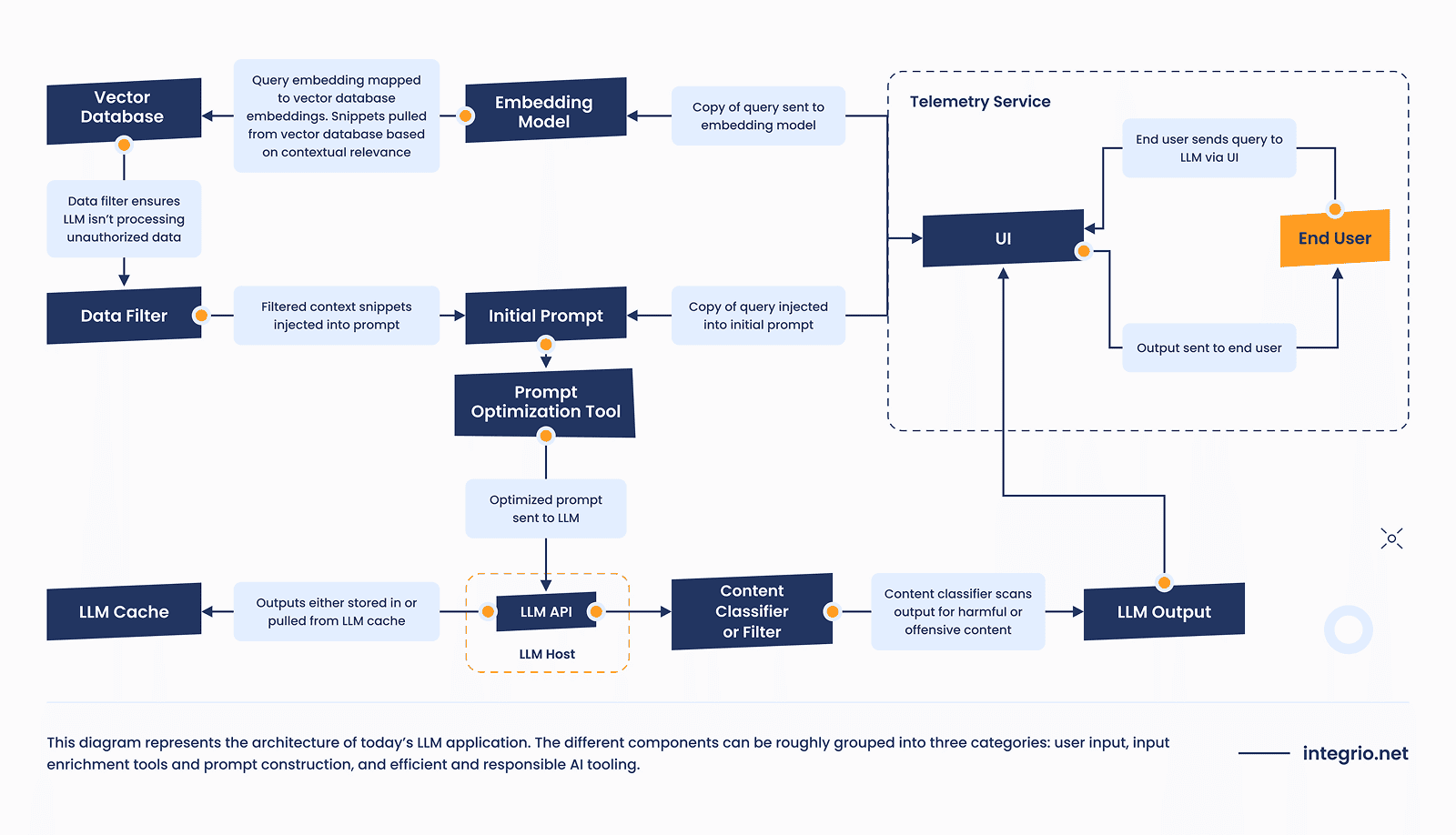
What happens under the hood when a user types in a prompt and hits Enter? Well, the exact answer depends on the LLM system design, of course. That said, let’s illustrate how information moves through a typical context engineering for LLM system that uses RAG for dynamic context retrieval:
- Data retrieval. The user sends the query via the UI. The system uses a copy of it to locate relevant information in a vector database (RAG) and find other potentially useful context in its memory (conversation history, user preferences, etc.).
- Preprocessing. The system filters context components to retrieve only the most relevant ones and normalizes and cleans data where necessary. It may also summarize or shorten information to reduce token and infrastructure costs.
- Context assembly. Context engineering tools assemble context components and add them to the user’s query and system instructions. The assembled prompt is then sent to the LLM as input.
- LLM call. The LLM generates a response based on the user input and the assembled context. The response goes through a content classifier or filter to ensure the output doesn’t contain harmful or offensive remarks.
- Post-processing. The response can be sent back to the user directly or used as input for other systems in multi-step workflows. If it’s the latter, the system runs validation checks on the output and prepares it for handoff through enrichment, reformatting, or standardization.
4 Real-World Use Cases
Context engineering isn’t theoretical these days; it’s effectively replaced prompt engineering in many LLM deployments. Here are just four real-world context engineering examples that show how this approach transforms AI applications:
- AI copilots. GitHub Copilot, an AI coding assistant, can ingest context from custom instruction files that contain global and task-specific rules. They can define how React components should be structured or how documentation should be formatted, for example. Claude Code, in turn, has its own context engineering template on GitHub.
- LLM-powered workflow automation. Salesforce supports context management for its AI agents, which spans prompts, instructions, tools, data inputs, and memory. For example, an AI agent can check the user’s loyalty tier and use conditional logic to craft and send an email that thanks them for their loyalty.
- Knowledge base assistants and chatbots. AI solutions like GoSearch provide a centralized enterprise search interface that can query all of the customer’s data sources. Its semantic search returns contextually relevant responses thanks to engineering.
- AI agents and task-oriented assistants. GitHub Copilot also allows users to create custom AI agents that specialize in specific tasks (e.g., documentation, API design). Each agent can come with its own set of tools, instructions, constraints, and behavior models.
Challenges and Limitations of Context Engineering
No context engineering tutorial would be complete without a word of warning. Context may now be called the “next frontier” in AI development, but it’s not perfect. It has its limitations. Namely:
- You still have context window constraints. Yes, they’ve grown to 1M+ tokens (unimaginable back in 2022), but they still represent a ceiling. Besides, model performance is shown to degrade as input size grows, so you might not want to max it out after all.
- Context creates token and infrastructure costs. Context has to be stored somewhere. That creates cloud costs. Then you have to send that context to the AI model, which adds to token costs. So, beware context stuffing — or you might blow through your budget.
- Latency increases as context grows. Similarly, the more context you send, the longer it takes the model to process it and generate the output. In multi-step workflows, the first step might take 400 ms, the fifteenth might take 2.5 s.
- You need to consider data privacy and access control. When AI systems need access to internal data — including customer or employee data — that creates an extra security risk. Context attacks are already a reality (look up prompt injection, for example).
- Context quality and relevance remain paramount. We can’t stress this enough: if the context you provide is stale or plain wrong, the output will not live up to your expectations. That’s why context engineering for LLM apps isn’t a one-and-done project: you have to continuously monitor and improve context quality and relevance.
Context Engineering Best Practices
So, how do you overcome these challenges — and get a good return on your investment into context engineering? In our experience, these five golden rules are the answer:
- Add only the context that’s relevant to the current task
- Prioritize adding useful information over inflating context volume or throwing in information “just in case”
- Identify and remove redundant or outdated context as fast as possible
- Test context strategies across real scenarios before deployment
- Continuously monitor model outputs and context quality in production
When You Need Context Engineering
Context engineering can do a lot, but it’s not a silver bullet. It can’t solve hallucinations, misalignment, or low-quality retrieval. However, it can improve relevance, reduce ambiguity, enhance reasoning, and scale workflows.
That’s why we don’t automatically jump to conclusions whenever we work on an LLM application. Instead, we study the project’s requirements to decide whether context engineering is the right approach for it first.
In our experience, your application is likely to need it if you’re:
- Scaling an AI product, and prompt engineering alone is no longer sustainable
- Working with large or frequently changing datasets, and retraining simply won’t be able to keep the model’s knowledge fresh
- Building production LLM systems that can’t rely on simple, demo-level RAG and/or prompt engineering
- Connecting the model to internal tools, APIs, and data sources to get relevant output
- Looking to manage memory, permissions, and application state in addition to user input
FAQ
Context engineering means designing, managing, and optimizing context — system instructions, conversation history, external data, and more — in LLM applications. Thanks to context engineering, LLM applications can return more specific, accurate, and relevant responses.
Prompt engineering focuses on input wording; developers create prompt templates for each use case. Context engineering is broader than prompt engineering; it involves setting up automatic, dynamic context provisioning. That context can include data from external sources, application state, and interaction history.
Pick the information the LLM absolutely needs to accomplish this specific task. Don’t add information “just in case”; that’s context stuffing, and it can bring down model performance. For example, if you’re building a customer support agent that answers questions about product documentation, don’t add the API documentation or recent tickets — the user manual is enough.
RAG is just one technique for retrieving external knowledge. Yes, it can be used in context engineering, but it’s not a “100% must-have” requirement.
Provide the most relevant, useful context for each query. Summarize it, or separate it into chunks and load only relevant ones into the LLM. Review context and remove redundant or outdated information. Consider integrating a RAG pipeline to retrieve up-to-date information.
Contact us
