The travel industry is rapidly advancing, propelled by Artificial Intelligence (AI). From chatbot-powered client service to predictive analytics shaping travel trends, artificial intelligence revolutionizes trip planning, booking, and experiences.
Travel companies are enhancing efficiency and customer satisfaction through AI-driven innovations. Like what? Personalized services, automated support, voice/facial recognition, virtual reality – just to name a few. In this article, we'll explore key AI applications, their benefits, and the most promising initiatives.
How Is Artificial Intelligence Changing the Tourism Industry?
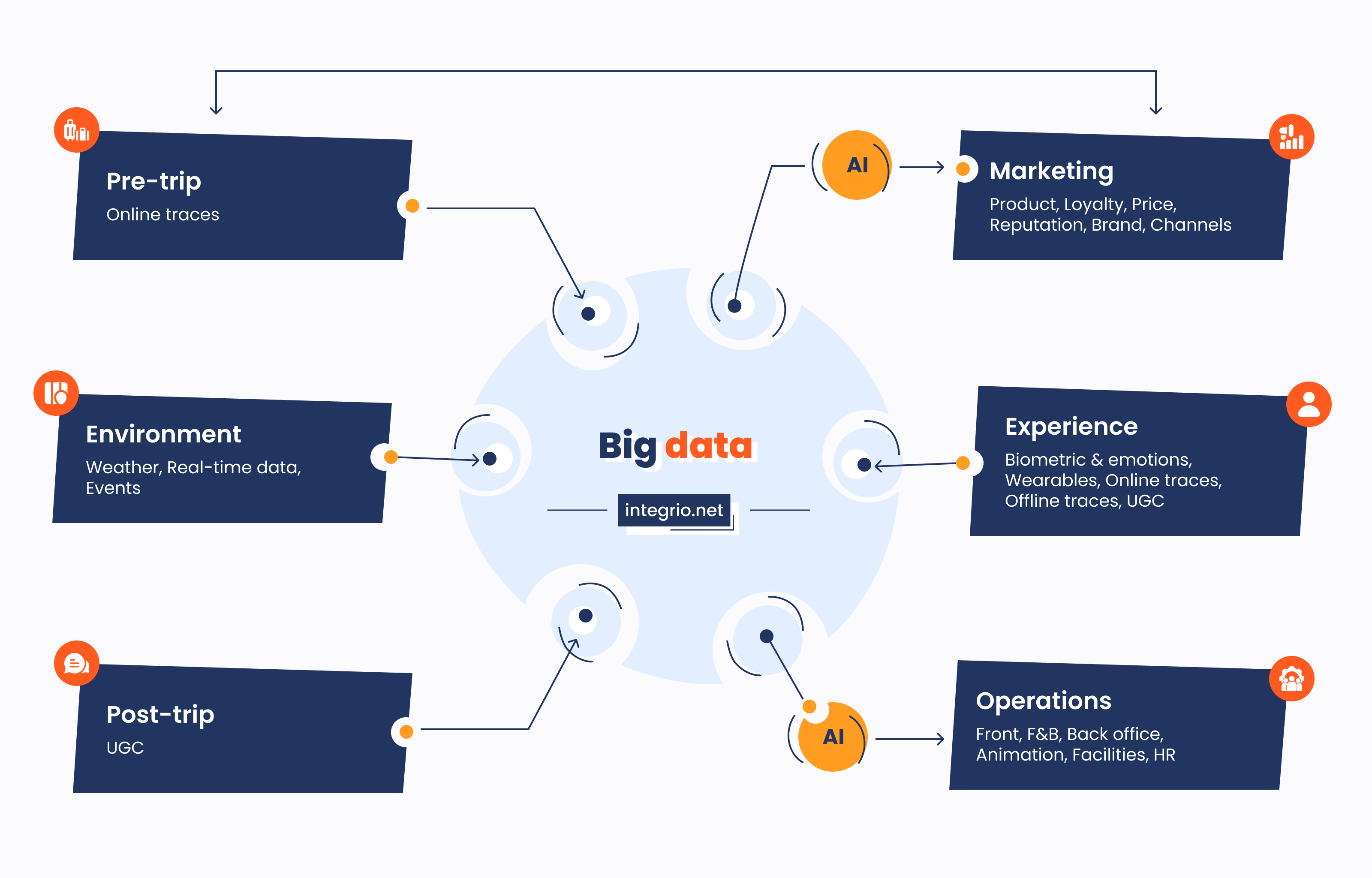
Big data is a fundamental building block for artificial intelligence, enabling systems to learn, recognize patterns, and generate insights. In tourism, big data comes from two main sources: the environment and the tourists themselves.
Environmental data includes meteorological conditions, real-time events, and feedback from IoT sensors.
Tourists contribute through various online and offline activities, biometrics, wearable devices, and user-generated content (UGC).
By aggregating data from these sources, user profiles are created to provide personalized product and service recommendations. In addition to marketing, AI affects internal business operations—from automating routine front and back office operations to creating an unforgettable guest experience through animation and facilities.
As for AI innovations in tourism, we want to highlight the following:
Smart Hotel Rooms with IOT
IoT sensors monitor room occupancy, temperature, and lighting settings, allowing for automatic adjustments to guest preferences. With simple voice commands, voice assistants enable people to control room amenities like lighting, temperature, and entertainment systems. In addition, intelligent thermostats, door locks and tablets for rooms increase convenience and security for guests.
Facial Recognition for Check-In and Boarding
Facial recognition technology has revolutionized check-in and boarding operations. Collecting and analyzing facial biometrics allows you to quickly and accurately verify travelers' identities, eliminating the need for IDs or boarding passes. This increases security measures and speeds up the check-in and boarding processes.
In addition, facial recognition systems identify VIP guests or frequent travelers and provide personalized services or upgrades.
AI-driven Applications for Flight Forecasting
Flight forecasting software analyzes vast historical and real-time data, including weather conditions, air traffic, and past flight characteristics. It allows companies to predict delays, flight cancellations, and disruptions.
By accurately predicting potential disruptions, airlines and travel agencies can give passengers advance notice, rebook flights, and mitigate the impact on travel routes. In addition, such systems optimize flight schedules, crew distribution, and fuel consumption.
Robots in Face-to-Face Customer Service
AI-powered robots equipped with natural language processing (NLP) capabilities can respond to customer inquiries, offer recommendations, and assist with various tasks. In hotels and airports, robots provide concierge and room services or help with check-in and baggage handling.
These robots constantly learn. They improve their interactions with guests, allowing staff to focus on more complex tasks. Also, they contribute to creating a futuristic and innovative atmosphere, distinguishing companies from competitors.
Smart Luggage Handling
Intelligent baggage handling systems simplify the process of bag transporting and tracking, reducing the risk of loss or mishandling. Thanks to IoT sensors and machine learning algorithms, you can track the luggage from check-in to the final destination. This ensures timely delivery and minimizes delays.
In addition, image recognition technology automatically sorts and routes luggage. This reduces physical labor and increases the efficiency of airlines and airports.
VR and AR
Virtual Reality (VR) and Augmented Reality (AR) technologies are changing how travelers plan, experience, and share their travels. Allow potential guests to virtually explore destinations, accommodations, and attractions, providing a realistic travel preview before booking.
In addition, VR and AR technologies enhance the on-site experience by providing interactive guides, navigation aids, and historical context. This enriches the overall travel experience and fosters deeper connections with destinations and cultures.
Conversational AI
Conversational AI is one of the most notable innovations in the traveler’s experience. It encompasses chatbots, voice assistants, and virtual agents that use NLP to understand, interpret, and generate human-like text or speech.
In fact, conversational AI is gaining prominence rapidly, with its global market forecasted to grow from $14.29 billion in 2025 to $41.39 billion in 2030. This kind of expansion is unsurprising, as conversational AI offers instant 24/7 support, effortless multilingual assistance, and the ability to handle thousands of conversations at once.
Machine Learning
While we’ve mostly centered on artificial intelligence in travel technology, it is also critical to discuss one of the foundational technologies behind these innovations: machine learning (ML). Machine learning is a subset of AI in which systems learn from data and perform actions based on that data, rather than relying on explicit programming instructions.
In the travel context, ML algorithms, such as clustering, classification, and deep neural networks, are deployed to solve complex, high-variable problems. Examples include predicting demand, recommending travel options, segmenting customers, or detecting fraud.
Examples of AI in Tourism
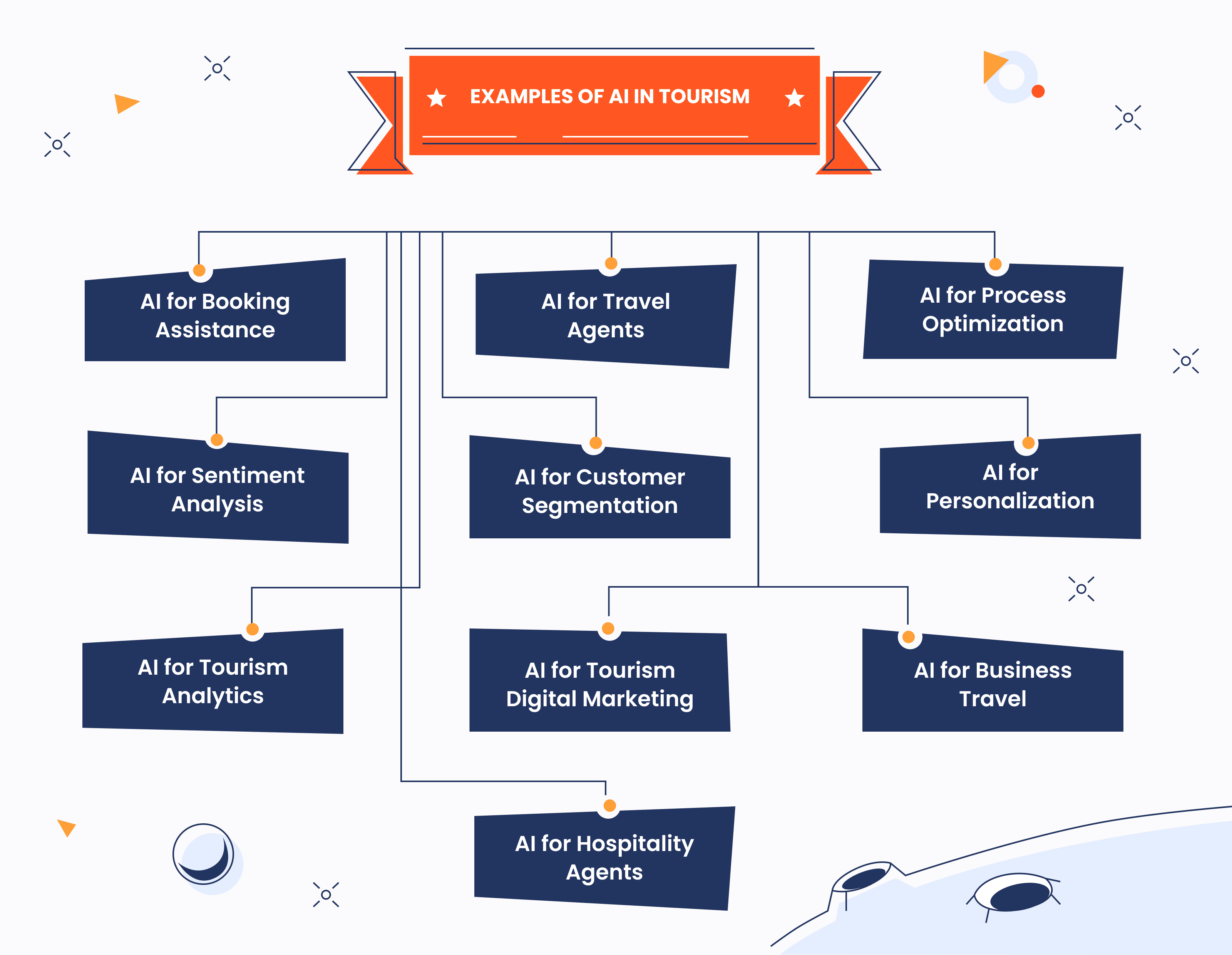
Artificial intelligence has significantly expanded its presence in the business realm over the past decade, with the travel industry witnessing widespread adoption in recent years. Here, we delve into the key use cases of AI in tourism.
AI for Booking Assistance
With the rise of online travel websites and the growing variety of travel choices, AI has become essential in helping travelers book their trips more easily. AI-powered chatbots and virtual assistants offer round-the-clock support, guiding users through the entire reservation process.
Leveraging conversational AI in tourism through NLP, systems comprehend user queries, preferences, and constraints for seamless communication and accurate recommendations. At the same time, machine learning algorithms analyze historical booking data, weather forecasts, and local events so businesses can predict demand fluctuations and optimize pricing strategies.
This not only enhances the user experience but also enables companies to maximize revenue by offering competitive prices and targeted promotions at the right time.
AI for Travel Agents
To provide first-class services, travel agencies also need modern technologies. For example, AI-enabled platforms that automate repetitive tasks and provide data-driven insights to improve decision-making.
These platforms use recommendation systems based on machine learning algorithms to suggest customized travel itineraries, accommodations, and activities based on individual preferences, past behavior, and demographic information. Natural language processing capabilities allow agents to quickly access the information they need and respond to client inquiries.
By combining human expertise and AI efficiency, travel agencies provide superior service and remain competitive.
AI for Process Optimization
The tourism industry relies on efficient processes to manage complex operations, optimize resource use, and deliver seamless experiences to travelers. Data analytics, machine learning, and automation make this possible.
Predictive analytics algorithms analyze historical data to optimize inventory management, pricing strategies, and staffing levels. Automating routine tasks like booking confirmations, check-ins, and customer service inquiries reduces costs and frees up staff to focus on higher value-added activities.
In addition, algorithms improve transportation logistics, route planning, and scheduling. This ensures timely and efficient service delivery while minimizing operational inefficiencies.
AI for Sentiment Analysis
Understanding customer sentiment is vital if you want to gauge satisfaction levels and address potential issues proactively. It can also identify emerging trends.
AI-powered sentiment analysis tools utilize NLP techniques to analyze textual data from reviews, social media posts, and feedback surveys. By classifying sentiments expressed in text as positive, negative, or neutral, these algorithms provide valuable insights into client perceptions and pain points.
Use this information to improve product and service quality, tailor marketing campaigns, and enhance customer engagement strategies. Real-time sentiment analysis enables businesses to detect potential crises and respond promptly to client concerns, fostering stronger relationships.
AI for Customer Segmentation
Effective client segmentation is essential for tourism businesses. It helps you target the right audience with personalized offers, promotions, and experiences. Employ AI to segment customers based on demographic characteristics, preferences, behavior, and purchase history.
Machine learning algorithms analyze large datasets to identify patterns and clusters within the client base so you can create targeted marketing campaigns and loyalty programs. Predictive modeling techniques forecast future travel preferences and behaviors, enabling businesses to anticipate customer needs and tailor offerings.
And what about content? Businesses increase conversion rates and guest satisfaction by delivering relevant and timely information to specific client segments.
AI for Personalization
Personalization is the key to delivering exceptional experiences and building long-term customer relationships. By segmenting guests, you can provide tailored recommendations and offers to users.
Understanding user intent and preferences is useful for offering relevant destinations, accommodations, activities, and dining options. Dynamic pricing algorithms adjust prices based on demand, availability, and user preferences, ensuring competitive pricing and maximizing revenue.
Real-time personalization enables companies to adapt to changing client preferences and market conditions, driving customer satisfaction and repeat deals.
AI for Tourism Analytics
Analytics is another decent application of AI in tourism. The process involves collecting, preparing, processing, and extracting insights from environmental and tourism data.
The useful sources of data you can use for further analysis include property management systems (PMS), customer relationship management (CRM) systems, website analytics solutions (Google Analytics, Google Search Console), financial reports, social media, marketing automation platforms, email newsletters, customer reviews, weather forecasts, and beyond.
Modern AI tools can then analyze collected data. There are three types, depending on your needs. The first and most important is general AI analysis tools, such as Claude AI and ChatGPT. Another category is solutions that automate AI workflows, including Make.com and Zapier. Finally, there are data visualization tools, such as Napkin AI, Power BI, Tableau, and Google Looker Studio.
AI for Tourism Digital Marketing
We’ve already mentioned some of the ways to leverage AI in tourism marketing, such as customer segmentation, sentiment analysis, and personalization. Let’s now discuss another facet of digital marketing: campaign creation and optimization.
Once you truly understand what your customers feel, think, and want, start creating marketing materials that resonate with those feelings, thoughts, and desires. AI tools are highly useful here. Whether you aim to attract more visitors to a spot or increase ticket sales, generative AI platforms, such as ChatGPT or Gemini, produce appealing marketing copy, emails, or ad creatives that help you meet your targets.
Moreover, if your initial advertising efforts fall short, AI allows you to optimize easily. Using travel artificial intelligence tools, you can brainstorm ideas and improvements to ensure your marketing efforts are successful and your advertising budgets are spent effectively.
AI for Business Travel
Business travel is a distinct and high-value sector that benefits immensely from the impact of artificial intelligence in tourism industry.
The unique needs of business (or corporate) travel include tight schedules, strict cost control, and the need for risk management strategies to address potential visa issues, traveler safety, and travel disruptions. Implementing AI is sometimes the only way to resolve these complexities in corporate travel.
In fact, according to a Serko and Sabre survey on AI for corporate travel in 2025, 44% of business travel managers consider that AI will “have a significant effect on their programs” in the next five years. Another 22% believe this tech will be “transformative, reshaping the industry at its core.”
How exactly does AI help? You can use it to create multi-city trip plans with meetings scheduled around travel. You also ensure expense and company policy compliance, as AI systems automatically flag out-of-policy bookings and offer optimal travel alternatives, balancing cost-saving with traveler convenience. Additionally, AI analyzes real-time data from geolocation services, news feeds, and global risk indices to proactively alert travelers and managers.
AI for Hospitality
Hotels, resorts, and short-stay accommodations use artificial intelligence tourism solutions to create seamless guest experiences and improve operational efficiency.
In particular, you can implement IoT and AI technologies, as we mentioned earlier, to turn hotel rooms smart. Using voice-enabled assistants for in-room service requests (housekeeping, concierge, and more) is another option at your disposal. And that’s not to mention streamlined check-in/out processes and personalized dining or activity suggestions.
As for the back-office operations, AI can simplify recruitment and enhance the overall employee experience. IT productivity sees a boost as routine tasks transition to self-service. Furthermore, AI reshapes financial reporting, fraud detection, and general analysis.
Benefits of Artificial Intelligence in Tourism
Artificial Intelligence improves the travel industry by streamlining processes traditionally handled by humans, thereby minimizing errors. Leveraging AI, the travel sector can predict travel preferences, offer personalized solutions, enhance customer service, and simplify in-trip and post-trip management.
Let’s discuss these and other notable benefits of AI in travel industry.
Operational Efficiency
Want to increase your overall efficiency? Try AI. With predictive analytics, you can easily reallocate resources and optimize inventory levels. Automating routine processes reduces manual workload, allowing staff to focus on more complex and strategic tasks. As a result, you improve productivity and minimize errors, reducing wait times.
Personalized Experience
Use past behavior, demographics, and contextual information to provide personalized recommendations for destinations, accommodations, activities, and dining options. By understanding user intent and preferences, companies can create customized itineraries and offers that suit each traveler. Personalized experiences strengthen emotional connections with customers, driving repeat deals and positive word-of-mouth referrals.
Precise Data Analysis
AI-powered data analysis tools enable tourism businesses to extract valuable insights from large and complex data sets. Machine learning algorithms analyze historical information to identify trends, patterns, and correlations. It gives companies actionable insights into customer behavior and market dynamics.
As a result, you can create marketing strategies, product development initiatives, and operational optimization, quickly reacting to the environment. Accurate data analysis allows businesses to predict market trends, mitigate risks, and capitalize on new opportunities.
Sustainable Tourism
Predictive analytics algorithms optimize transport routes, reducing fuel consumption and carbon dioxide emissions and maximizing efficiency. AI-based monitoring systems track energy use, water consumption, and waste generation. In this way, you identify opportunities to improve efficiency and conserve resources.
By promoting responsible tourism and supporting environmental initiatives, AI contributes to preserving natural habitats and cultural heritage.
Sales & Marketing Improvement
Sales and marketing solutions based on artificial intelligence allow tourism businesses to target the right audience and increase conversion rates.
For example, recommendation engines provide personalized content and offers, increasing engagement and conversion. Predictive analytics algorithms identify high-value segments and tailor marketing campaigns accordingly. Automated marketing platforms optimize ad placement, timing, and messaging, maximizing ROI and profit.
Accurate Forecasting
Machine learning algorithms analyze historical data, market trends, and external factors to generate reliable predictions about bookings, revenue, and resource usage. It facilitates strategic planning, resource allocation, and pricing decisions, helping you optimize operations. Accurate forecasting minimizes the risk of overbooking and revenue loss, ensuring optimal productivity and profitability.
Better Price Matching
Better price matching improves customer satisfaction, driving loyalty and repeat purchases. At the same time, you maximize your income for competitiveness.
Dynamic pricing models adjust prices in real time based on demand, availability, and client segmentation. Analyze large volumes of data to determine the optimal pricing strategy for each product or service. And then, set competitive prices that reflect market demand, competitor prices, and customer preferences.
Fraud Prevention
Reduce the risk of payment fraud, identity theft, and account hijacking by detecting it before it causes financial or reputational damage.
Machine learning algorithms analyze transaction data, user behavior, and historical patterns to detect suspicious activity and anomalies in real time. AI technologies protect companies and customers from potential security threats by providing a safe and secure environment for transactions and interactions.
Ethical Use of AI in Travel and Tourism
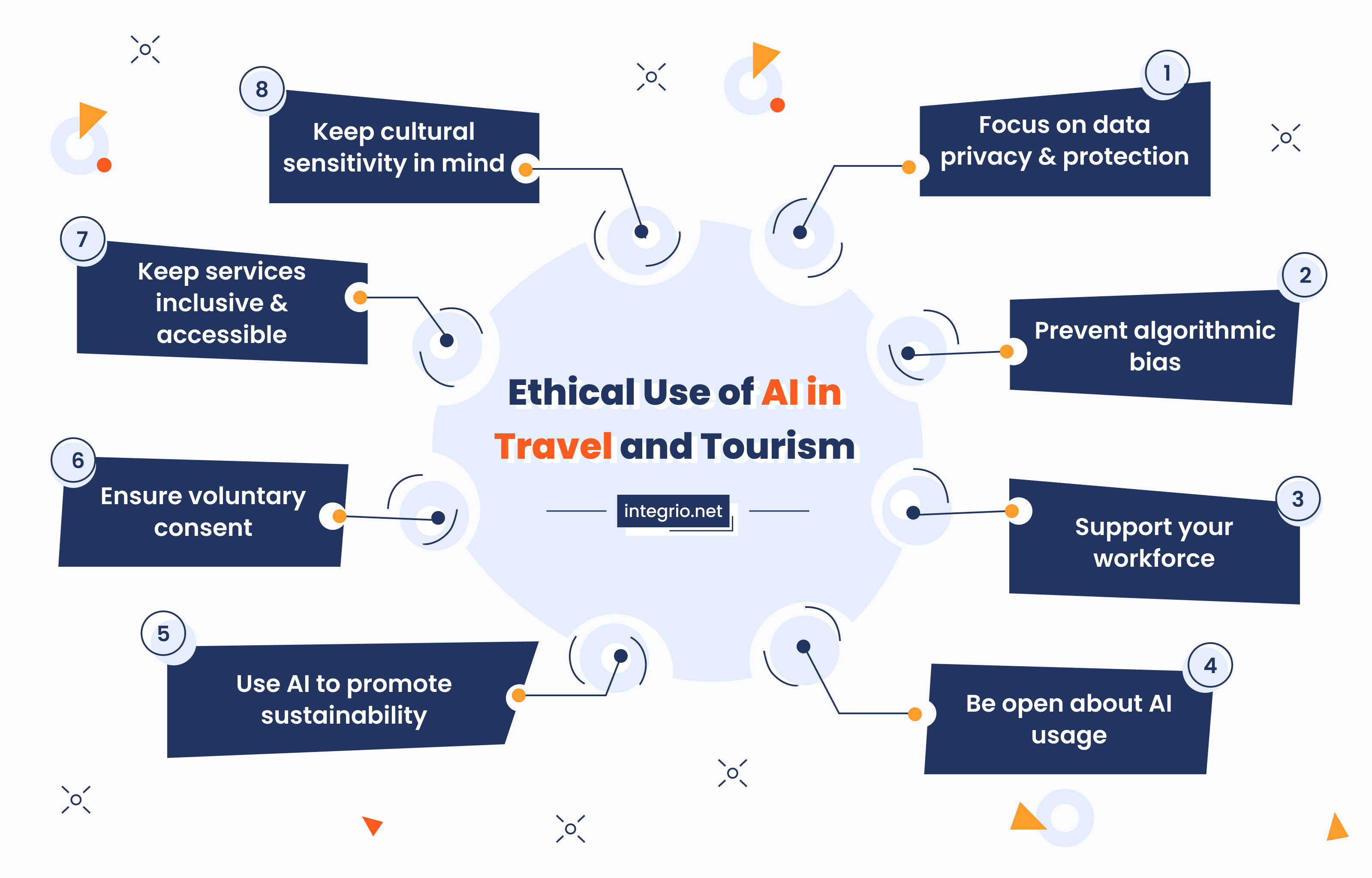
AI is beneficial for travel and tourism companies, offering better forecasting, price matching, customer experience, operational efficiency, and beyond. Yet, these numerous advantages are only noticeable when you use AI responsibly. Here’s what ethical AI implementation in the travel sector looks like.
Focus on data privacy and protection. Travelers input extremely sensitive information about themselves. You need to handle that data in a trustworthy manner. Clearly communicate what, why, and how you collect and use.
Prevent algorithmic bias. AI models can inadvertently favor certain traveler groups over others if they are trained on lopsided or incomplete data. Make sure you regularly audit your algorithms and work with diverse datasets.
Support your workforce. AI certainly handles routine tasks and reduces manual work. Yet, that doesn’t mean it can replace humans entirely. Implement AI to enhance human roles.
Be open about AI usage. Travelers should always know when they interact with an AI system. Make this obvious to them.
Use AI to promote sustainability. By leveraging AI’s predictions and marketing precision, you can unintentionally promote overtourism. The truly ethical use means applying the tech to reduce waste, optimize energy usage, and encourage customers to select eco-friendly travel predictive amenities.
Ensure voluntary consent. Some technologies, such as location tracking or behavioral analytics, require additional clarity. Make it clear what your AI system does and allow travelers to opt out.
Keep services inclusive and accessible. AI shouldn’t create a gap between tech-savvy travelers and those who prefer more traditional interactions. Provide accessible, intuitive designs and offer a non-AI alternative.
Keep cultural sensitivity in mind. Content and recommendations curated by AI must reflect local customs, values, and beliefs — not disrespect them. Collaborate with local experts, monitor your AI model’s outputs, and make sure you celebrate cultural heritage.
Create a Better Travel Experience with Integrio
AI in tourism offers many benefits that redefine how businesses operate and serve their customers. Employing such a technology, you get personalized recommendations, enhanced client service through chatbots and intelligent assistants, optimized marketing efforts through prediction engines and recommendation systems, and other benefits. Artificial intelligence enables businesses to anticipate traveler behavior, tailor experiences, and drive efficiency.
Yet, successfully integrating AI into tourism operations requires expertise and experience. Finding a reliable software development provider becomes paramount to effectively navigating the complexities of AI implementation. Integrio has a proven track record in delivering AI services for hospitality, manufacturing, telecommunication, healthcare, and other industries.
For example, we allow you to harness prediction engines, cluster analysis, and recommendation systems to anticipate customer behavior and optimize marketing efforts. Additionally, our team provides advanced capabilities such as biometric data analysis, POS analytics, coupon automation, and AI-powered A/B testing, driving efficiency and innovation.
By partnering with Integrio, tourism companies access comprehensive expertise and support, ensuring seamless adoption and realization of AI’s power. Contact our team today to discuss your project.
FAQ
AI in tourism helps make travel experiences more personalized, efficient, and engaging. Travelers benefit from tools that assist in trip planning, booking assistance, real-time translation, and on-demand recommendations. Travel agencies, in turn, use AI for customer service, dynamic pricing, sentiment analysis, customer segmentation, fraud detection, and overall process optimization.
Machine learning enhances targeted travel marketing through several solutions: personalization engines that recommend destinations, services, and content based on user profiles, dynamic content optimization that adapts website or ad content, and AI chatbots that provide customer support and booking assistance. Other options within water-based tourism marketing automation software include customer segmentation, enabling more precise targeting, campaign optimization, improving ad performance, and predictive analytics, allowing businesses to forecast demand and prices.
AI improves travel analytics and reporting through predictive modeling, automated data processing, and extraction of traveler insights. It handles large data volumes with ease, enabling businesses to predict demand, optimize pricing, tailor recommendations, spot operational bottlenecks, and generally make smarter, more lucrative decisions.
AI supports sustainable business travel by helping organizations reduce emissions and operational waste, as well as make more informed decisions on their resource usage. This is possible thanks to route optimization, eco-friendly transportation/accommodation recommendations, and real-time sustainability metrics monitoring.
Utilizing AI in the tourism industry often presents several challenges. The top one is data privacy and protection, given the amount of personal information involved. Overreliance on automation can lead to another issue — the loss of the human touch that travelers value. Completing the list are potential job displacements, AI implementation costs and complexity, risks of biased or incorrect recommendations, and ethical and compliance considerations.
AI is currently being widely adopted in the travel and tourism sector, primarily driven by customer demand, operational needs, and growing investment. The most common AI use cases in travel and tourism in 2025 include personalized trip planning and suggestions, optimized internal operations, sustainability initiatives, and improved customer service.
We use cookies and other tracking technologies to improve your browsing experience on our website. By browsing our website, you consent to our use of cookies and other tracking technologies.