
AI Recommendation Engines: Business Owner’s Ultimate Guide


Consumers expect to be seen as more than just a customer ID. They want to feel catered to. Luckily, the data you need to meet their expectations is already there. You just need a recommendation engine to capture and make sense of it.
Of course, implementing AI recommendation engines is easier said than done. That’s why we decided to share our wealth of knowledge on the topic in this guide. Keep reading to find out:
- What recommendation engines are
- How they work
- Why integrate one into your systems
- What challenges you might encounter along the way
- How to decide whether to buy or build one
- How to get started with recommendation systems
- How to build a custom AI recommendation engine
What Are Recommendation Engines?
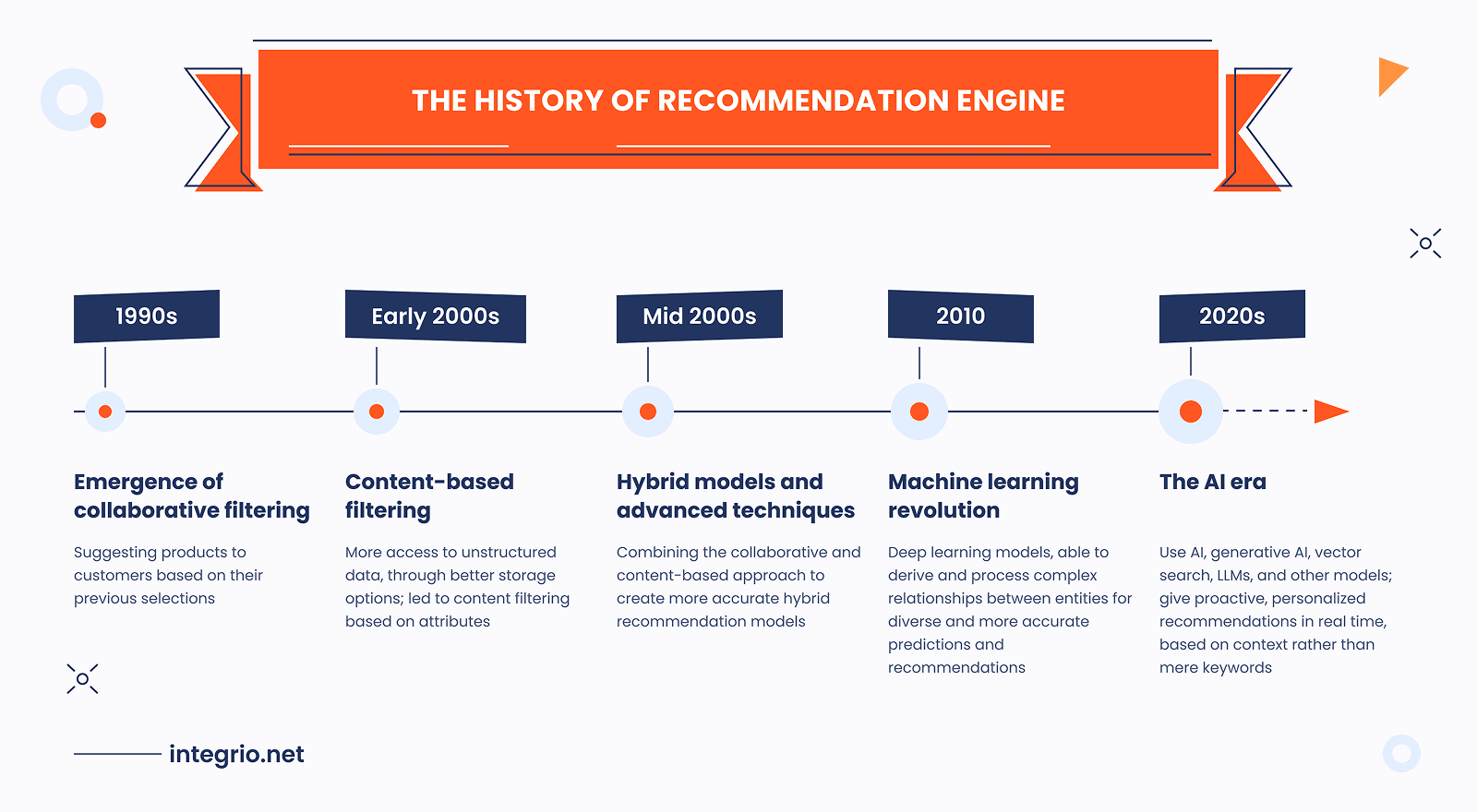
Today’s recommendation engines use AI to analyze large volumes of data and determine the most relevant content, services, products, or actions for the user. They power everything from upselling suggestions on eCommerce websites to feature discovery in SaaS products.
From a technical standpoint, AI recommendation engines are data filtering tools that identify patterns in data using machine learning algorithms. To that end, they process data and calculate correlations between multiple variables (attributes, features).
You don’t have to go far to find everyday recommendation engine examples:
- Netflix tracks user interactions and predicts which content users are likely to interact with next. That’s how Netflix creates personalized suggestions like “Today’s Top Picks for You.”
- Amazon has been using collaborative filtering for product recommendations for years. These days, the company also leverages generative AI to personalize product descriptions on the fly.
- Spotify analyzes artist-provided metadata and raw audio data to score and categorize each track. The recommendation engine also analyzes user behavior and suggests tracks that similar users enjoyed.
AI recommendations aren’t just a fancy, good-to-have feature anymore. Most consumers (71%, according to McKinsey) expect personalized interactions from companies. Even more (76%) will get frustrated if the company doesn’t live up to their expectations in that regard.
Apart from meeting those expectations, AI recommendations also help businesses:
- Speed up content or feature discovery
- Boost order value and customer lifetime value
- Increase conversions and retention
- Improve marketing ROI
- Ensure resilience when demand shifts
How Recommendation Engines Work
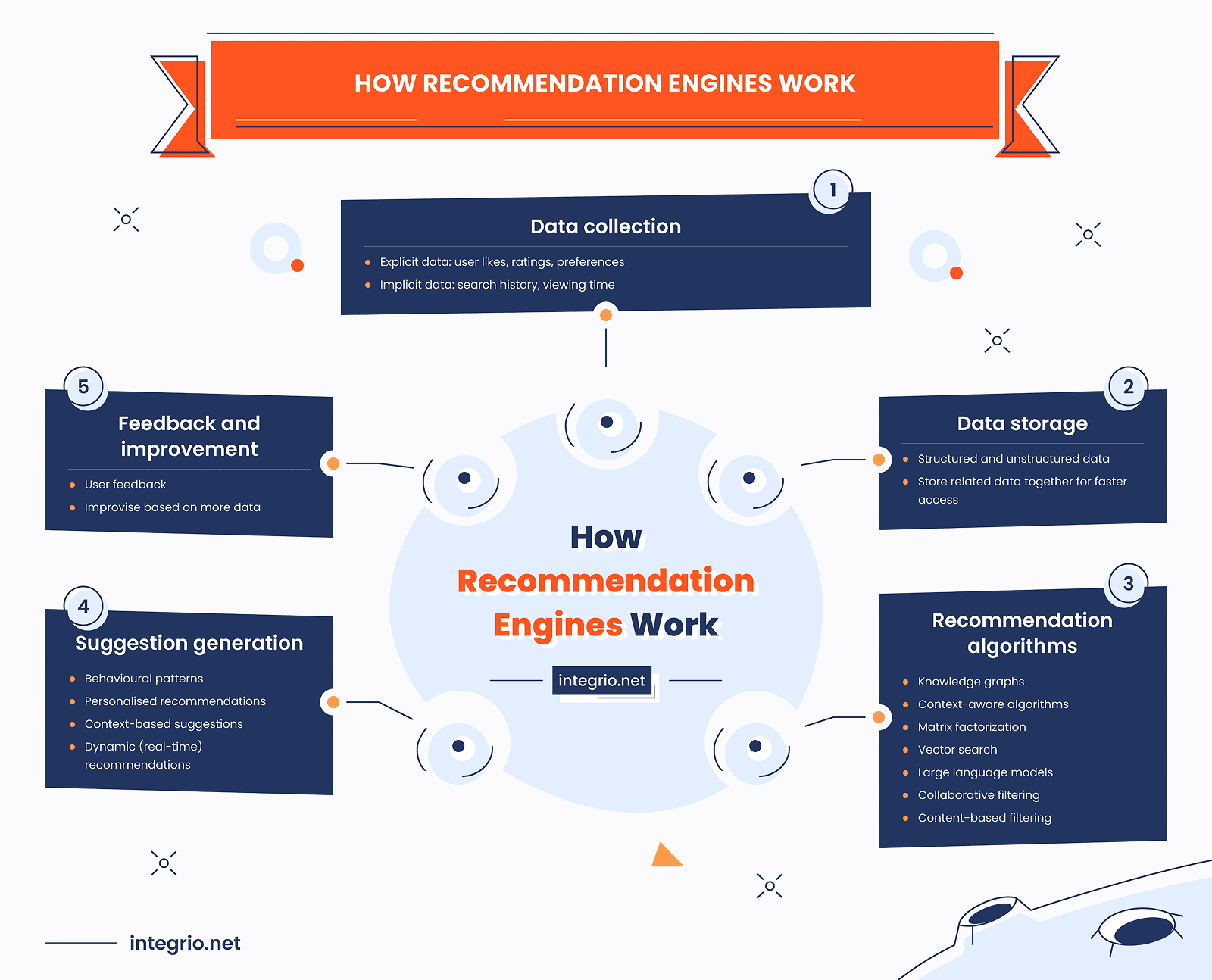
To do what they’re meant to do, online recommendation engines need two things: data (a lot of it) and an AI model trained to find patterns and identify the most relevant items in real time. Here’s how these two broad elements come together to power recommendations:
- Collecting data. Recommendation engines need user and product/service/content data first. They gather both implicit (collected from user activity) and explicit (communicated by the user) data to identify similar customers and products.
- Storing data. Before the data can be analyzed, it has to be cleaned, processed, and added to storage first. Since engines deal with a lot of data, the storage has to be scalable and support high-velocity operations. Modern systems typically use data lakehouses and data stores.
- Training the model. The recommendation system learns user preferences by identifying patterns and correlations in the training datasets. Based on the identified correlations, the system can predict user preferences.
- Serving recommendations. Once the model is validated and deployed, it’s ready to serve recommendations. To that end, most engines narrow down the whole catalog to a few hundred items (candidates), assign relevance scores, and serve the high-scoring candidate(s).
- Continuously improving. When designed right, engines use feedback loops to refine their own accuracy. You will also need to periodically retrain yours to adapt it to new business goals or changing data.
4 Core Technologies Powering Recommendations
As we’ve mentioned before, today, companies are using AI for recommendation engines. But AI is a vast discipline that encompasses tons of different technologies. So, we won’t leave it at that.
In practice, online recommendation engines are typically based on:
- Machine learning. In recommendation engines, machine learning is the foundational technology powering statistical analysis. They discern patterns in past and real-time data, filter and score recommendation candidates, and rank them. Bayesian classifiers, decision trees, and clustering are common ML algorithms for recommendations.
- Deep learning. A machine learning subdomain, deep learning produces models capable of extracting complex patterns from structured and unstructured data. They can process images, text, and user data from multiple sources more effectively than ML algorithms; however, they need more data for training. Deep learning engines can use neural networks (CNNs, RNNs), autoencoders, and transformer models.
- Large language models. LLM-powered engines are the new wave of recommendation systems that can reason about user preferences and context with more precision. They can also tweak copy in real time to adapt it to every user (see Amazon’s example above for more information).
- Vector embeddings. They convert users, items, and interactions into numerical representations (vectors). Embeddings facilitate identifying relationships between entities and patterns in data.
Types of Recommendation Engines to Know
Under the hood, AI personalization engines may use different approaches to identifying and serving the most relevant recommendations. The four of them are:
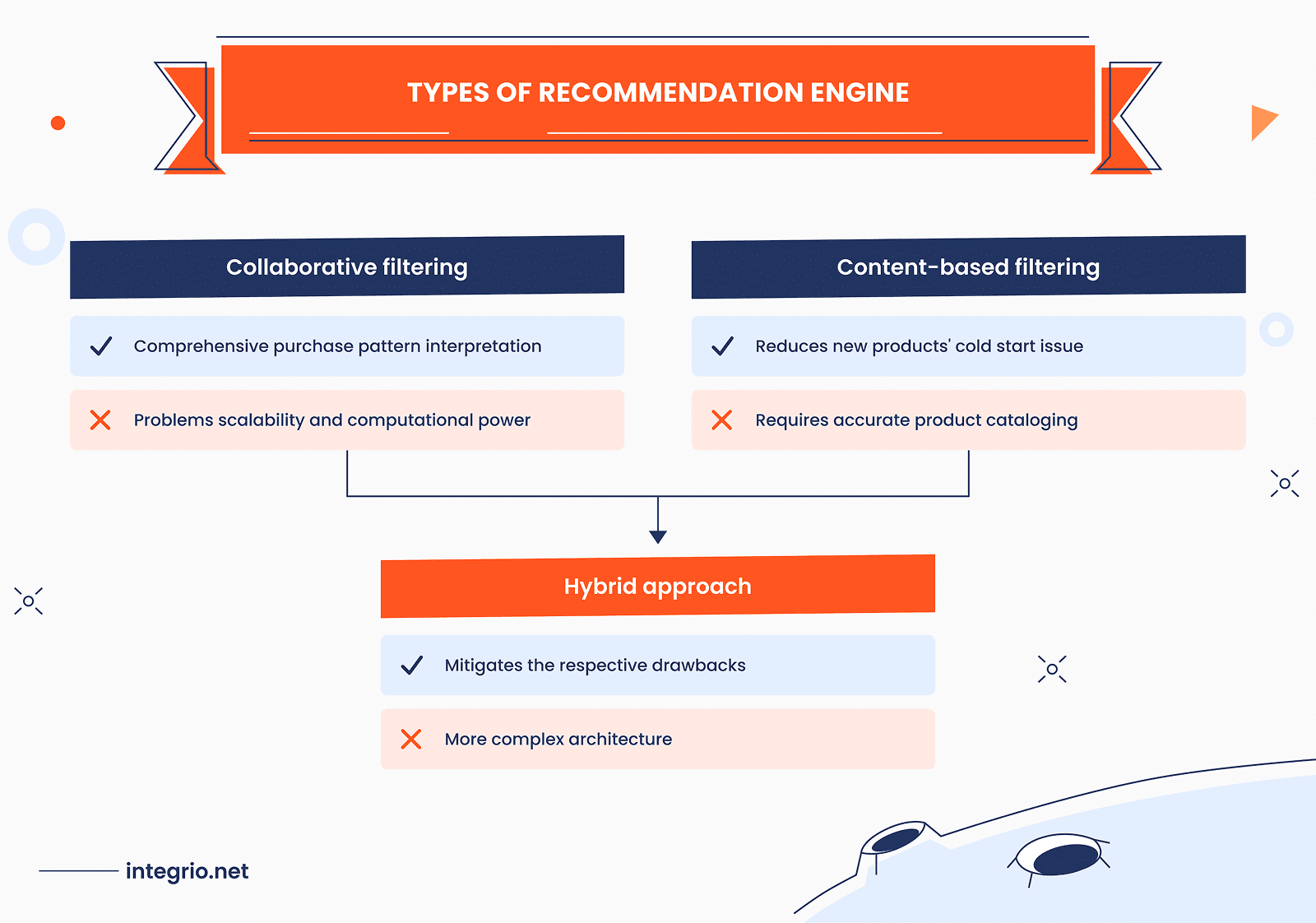
- Collaborative filtering. The oldest approach on this list, it relies on user similarity scores to serve recommendations. Essentially, it’s behind recommendations like “Others like you enjoy…” Collaborative filtering is easier to implement since it doesn’t need to analyze products, but it creates a cold start problem (no data for new users or items).
- Content-based filtering. In contrast, this approach analyzes the item’s characteristics and determines how well they match user preferences. So, it can produce more accurate results even for new users, despite limited user data. That said, accurate product catalogs are a must for training such engines.
- Hybrid recommendation systems. These systems bring the best of both worlds, albeit at the cost of more complex architecture. Hybridization techniques range from mixed (both collaborative and content-based suggestions served) to weighted (merging scores) and meta-level (using the collaborative filtering output as input for content-based suggestions).
- Knowledge-based recommendation systems. These systems rely on explicit user input or queries, not past behavior. They’re common in high-value domains where other approaches aren’t viable (insurance, real estate, vehicle purchases, travel planning). These systems also eliminate the cold start problem.
Benefits Businesses Can Reap with AI Recommendations
As we’ve already mentioned, personalization is no longer an extra; it’s an implicit expectation. Recommendation systems are the only way to power that personalization in real time and at scale.
Not sure about the ROI of integrating a recommendation system? Take these five benefits into account:
- Real-time personalization. Consumers don’t expect personalization, period; they want it in real time. Over half of Americans state so, according to Amperity. No amount of human labor can deliver instant recommendations like an AI model can.
- Revenue growth from recommendations. The same Amperity study also showed that 69% of consumers are more likely to buy when presented with instant recommendations. Amazon, for example, has recommendation systems to thank for 35% of its sales.
- More relevant customer journeys. Recommendations can prevent churn, adapt promotions, and find the right offer to finalize conversion. All of that also translates into higher revenue. A Medallia report found that brands with stronger personalization capabilities are twice as likely to have 10%+ higher revenue.
- Adaptive recommendation models. Modern recommendation systems adapt their recommendations based on new user data or context, all in real time. That’s a more effective, responsive approach than sorting users into “buckets” and manually creating customer journeys for each category. Adaptive models also instantly respond to shifts in behavior, thus making sure you don’t miss out on an upselling or conversion opportunity.
- Continuous learning from user behavior. Similarly, recommendations improve over time, all thanks to real-time explicit and implicit user feedback. That enables them to provide more accurate suggestions in the long run.
How Different Industries Use AI Recommendations
From AI event recommendation engines to content discovery queues, recommendation systems are present in virtually any industry today. We wouldn’t be able to cover them all within a single blog post. So, let’s focus on how they are used in six particular industries.
eCommerce
eCommerce companies basically pioneered recommendation systems. Today, they help upsell and cross-sell, convert visitors, personalize content, and more with:
- Personalized product recommendations
- Cross-sell and upsell recommendations
- Frequently bought together suggestions
- Dynamic homepage personalization
Media & Entertainment
Services like Netflix have long used content recommendation engines, too. They help keep users engaged with:
- Personalized content recommendations
- Watch-time optimization
- Content discovery
- Viewer retention strategies
Banking & Fintech
Implementing recommendation systems in this industry is a somewhat delicate matter: they may have to handle highly sensitive data like financial transaction history, after all. Despite this challenge, they’re becoming more popular, in the form of:
- Personalized financial product recommendations
- Next-best-action recommendations
- Personalized investment recommendations
- Context-aware customer offers
- AI-powered insurance recommendation engines
Omnichannel Retail
The benefits of AI recommendation engines in retail range from revenue uplift thanks to personalized promos to reduced customer churn. Their common use cases include:
- Omnichannel personalization
- Inventory-aware recommendations
- Personalized promotions
- Store-specific product assortments
SaaS & Digital Products
In this domain, recommendations help users discover software products and make the most of them, improving user engagement, retention, and conversion. They do it by powering:
- Feature discovery
- Personalized onboarding
- Usage-based recommendations
- Next-best actions
Healthcare
Like in finance, using recommendation engines in healthcare is more challenging due to tighter privacy protections (e.g., HIPAA). That said, they can make a tangible impact on the quality of care and patient outcomes with:
- Patient-specific care recommendations
- Follow-up recommendations
- Patient journey optimization
- Preventive care guidance
Why Building Recommendation Engines Isn’t Easy: 5 Challenges
Even the top recommendation engines aren’t immune to challenges like:
- Cold start problem. Whenever a new user or product appears in the dataset, the model may struggle to create accurate suggestions since the data it can draw on is limited. Falling back on content-based filtering for early suggestions and asking users about their preferences during onboarding are two ways to overcome this problem.
- Data sparsity. If your catalog is as large as Netflix’s or Amazon’s, no users will interact with all of it. So, the algorithm might lack data to discern patterns. Collect implicit user signals and take content-based signals into account to avoid this problem.
- Scalability. Growth is great news for your business, but the AI recommendation engine may struggle with spikes in the number of users or the size of your catalog. So, implement caching for frequent recommendations and use GPU-powered inference.
- Real-time processing. User preferences and demand trends can shift on a dime, and your recommendation system should be ready to adapt as fast. However, real-time adaptability is an engineering problem. You can solve it with real-time feedback loops and data streaming.
- Privacy concerns. It’s a paradox: consumers want personalized experiences, but they’re also wary of handing over personal data to companies. Any recommendation engine has to strike a fine balance between the two — and fall in line with regulations like CCPA, GDPR, and PIPEDA.
Build vs Buy: What Should You Choose?
Ah, the age-old question: Should you build your own recommendation system or integrate an off-the-shelf one? As always, the answer is somewhat frustrating: it depends. An eCommerce SME can make do with a native Shopify integration for product recommendations. A SaaS startup that makes personalization part of the product’s USP can’t make do with a vendor solution.
Here’s how your two options compare:
| Aspect | Off-the-shelf systems | Custom engines |
|---|---|---|
| Deployment | Faster | Slower |
| Integrations | Limited by the vendor Works fine for standard integrations (eCommerce platforms, CMSs, CDPs) | No limitations (except technical ones) Can support integrations with homegrown systems and unusual catalogs |
| Logic | Geared towards common product, content, and user similarity patterns | Can be fully customized to reflect complex constraints or requirements |
| Governance, security, and privacy | Ultimately depends on the vendor Creates a third-party risk May be incompatible with strict legal requirements | Ultimately falls on your shoulders Possible to align with strict regulatory requirements Requires auditability by design |
| Costs | Less expensive to set up Running costs depend on the vendor and may increase with growing user count, revenue, or data volumes | Higher upfront costs Running costs are present but easier to manage through architectural decisions |
| Data control | Limited; the vendor controls the schema, feature support, retention, etc. | Complete; you’re in control of feature engineering, access, storage, feedback, etc. |
In our experience, building recommendation engines makes sense when:
- Your engine has to work with proprietary data signals (B2B account-level dynamics, regulatory filters, etc.) or niche product categories
- Personalization is key to your product’s differentiation
- You have enough historical data to train the model
- You have the expertise in-house to oversee and maintain the engine long-term
At the end of the day, the buy vs build debate comes down to cost vs flexibility. Off-the-shelf solutions cost less and are faster to implement, but you’re limited by the vendor’s supported signals, schemas, and integrations. Custom engines require a higher upfront cost, but they give you total control over the data, logic, integrations, and governance.
When Does Your Business Need a Recommendation Engine?
Not to state the obvious, but not every business needs an AI recommendation engine. If you’ve just launched your LMS and don’t have enough user data or a large catalog yet, even the best AI recommendation engines in LMS software may not be effective. In that case, you may be better off with rule-based suggestions instead.
In our experience with ML and conversational AI services, you should go for AI recommendations if your business sees:
- Growing product or content catalog. AI recommendations prevent choice overload, which happens when users have too many options to choose from. If your catalog spans hundreds or thousands of items, AI recommendations are also more effective at pinpointing the right suggestions for each user.
- Increasing user behavior data. We can’t stress this enough: you need enough data for the AI recommendation engine to work with. If you don’t have that interaction data (clicks, watch history, purchases, etc.), you can make do with a simpler recommendation system.
- Limited results from rule-based recommendations. Before AI came into play, businesses used to rely on explicit customer feedback (e.g., ratings) or manual selection (e.g., editor’s picks). If you notice that those rule-based recommendations have low conversion rates, they probably fail to appeal to users.
- Demand for real-time personalization. Of course, users may not always outright tell you they want real-time personalization. But you can piece it together. Do they expect experiences similar to your competitors that already serve real-time recommendations? Do their interests change during a session? If so, AI recommendations are the way to go.
- Multiple customer touchpoints. Different channels may produce inconsistent personalization. AI recommendations can solve this problem by analyzing diverse data from multiple sources and serving consistent suggestions across systems.
How to Get Started with AI Recommendations
Certain that a recommendation engine will be a net positive for your business? Here’s what you should do before jumping into the technical decisions:
- Define recommendation goals. What business metric(s) do you want to improve with recommendations? Revenue? Conversions? Engagement? Answer this question before doing anything else.
- Decide what you want to recommend. The choice might be obvious: if you’re a retailer, you’ll likely focus on product recommendations, for example. But in finance, insurance, or B2B sales, the choice may not be as straightforward. So, give it enough thought.
- Prepare behavioral and business data. User interaction data can include browsing and search history, purchases, clicks, skips, etc. Business data concerns the catalog of items to be recommended, which should be accompanied by clean attributes, taxonomy, and metadata. Clean both datasets to prepare them for the AI model.
- Select the right recommendation strategy. A global recommendation strategy focuses on trends across the customer base. A contextual one, as the name suggests, considers the user’s context (product viewing, browsing behavior). A personalized strategy uses individual customer data to cater to their specific preferences.
- Measure and continuously improve. Of course, you’ll need some way to know whether your investment is paying off. Tie the metrics to the business goals (e.g., watch time or CTR for engagement). Add technical metrics to the mix, too (e.g., RMSE for accuracy). Decide how you’ll be tracking them and set benchmarks, too.
How to Build an AI Recommendation Engine, Step by Step
Confirmed a custom AI recommendation engine is the right choice for you? Here’s what to expect from the development process, as per our experience with AI development services.
Step 1: Define the Recommendation Use Case
Determine how exactly the user will be served AI recommendations and how they’ll interact with those. Start with business use cases, i.e., ones that describe the user’s and system’s actions. Then, prepare system use cases that describe user interactions in intricate detail. These use cases will inform technical decisions down the line.
Step 2: Assess Available Data
Take stock of the available user and business data assets. Consider adding external data to the mix, too. Identify which data you can use for recommendations; clean and standardize it. Then, derive meaningful features from raw data (this process is known as feature engineering). For example, you can use average rating or purchase frequency as features from user data.
Step 3: Select the Right Recommendation Approach
The available data and use cases will dictate your decision here. Lack of user data, for example, will likely steer your choice toward content-based filtering. In insurance or real estate, in turn, knowledge-based engines will probably be a more suitable option.
Step 4: Build and Integrate the Recommendation Engine
This is where the magic happens. If you have AI/ML engineering expertise in-house, your team builds the model, trains it on your data, tests it, and fine-tunes it until it’s ready for deployment. If you lack the said expertise, turn to a development partner with solid experience in AI/ML development and recommendation systems.
Step 5: Evaluate and Improve Recommendation Performance
Evaluation is the final battery of tests that validates the model’s readiness for production. But like any other AI model, a recommendation engine isn’t a “set-and-forget” feature. You’ll need to monitor its performance and retrain it on new data in the future, too.
Conclusion
Implementing an AI recommendation engine isn’t as simple as saying, “I want to add recommendations to my website.” You have to take stock of your data, pick the right strategy and type, and make the never-easy buy vs build decision. That’s not to mention the intricacies of actually building, training, fine-tuning, and validating a custom engine if you go for one.
Don’t know where to get started? Or need an AI/ML expert to implement your recommendation engine without a hiccup? Get in touch with Integrio’s experts. We’ll help you make the right business and technical decisions — and integrate a recommendation engine that delivers real ROI into your systems.
FAQ
Accuracy depends on everything from the type of recommendation engine to data availability and the bias mitigation techniques used. Overall, AI in recommendation engines can be highly accurate, especially as they continuously learn from real-world data.
Absolutely. Simple rule-based or hybrid counterparts can still offer a good ROI for small businesses. Data scarcity is the main problem here, and these types of engines can work with limited data to produce relevant recommendations.
You’ll need user behavior data (clicks, views, etc.), demographic data, and contextual data (time of day, device used, etc.). Feedback (reviews, ratings) and item data are also necessary. That said, the exact range of data depends on the type of recommendation system and its underlying goals.
It depends. If you’re integrating an off-the-shelf recommendation engine, it can be a matter of days or weeks. Building a custom one will take weeks or months. We can give you an idea of how fast your recommendation engine can be up and running; just tell us about your project first.
They can be, provided you account for GDPR requirements during the engine’s integration. Those include collecting explicit, informed consent for data collection and storage, as well as allowing users to opt out and delete their data at any moment.
Contact us
