Artificial Intelligence (AI) is an interdisciplinary field of computer science associated with smart technology capable of undergoing tasks with little to no human input.
“As AI simulates or mimics human intelligence, it’s called Artificial Intelligence.”
The most notable contributions of AI lie in the fields of Machine Learning, and Deep Learning. Machine Learning carries out extensive data analysis on the behalf of humans.
Machine Learning in Real Estate
Machine Learning is a foundational element of AI in the real estate context. It works by observing data sets and finding patterns to achieve reliable decisions, without being specifically programmed to do so. The ability of systems to learn automatically from the provided data, and using it for future decision-making is indeed a great technological advancement in the field of AI.
Deep Learning, on the other hand, is a subfield of Machine Learning, focused on replicating the human brain to perform certain tasks. For instance, virtual assistants, driverless automobiles, personalized feeds on social media platforms, and facial recognition are all a product of Deep Learning algorithms.
Both Machine Learning and Deep Learning are extensively leveraged into the real estate industry to perform a wide range of technical tasks. For instance, Deep Learning is actively used in real estate mobile apps to assist brokers, tenants, and property owners. It assists the potential property buyers in getting a more personalized feed, thus increasing the chance of sales.
While the use cases of Machine Learning in the real estate industry may seem minor when compared with other technological innovations already seen in this industry, Machine Learning assists real estate agents in predicting property market values and making sound decisions without human intervention.
Challenges of artificial intelligence in the real estate industry
The use of artificial intelligence for real estate comes with great challenges, but thankfully, not unachievable ones. Firstly, AI in any sector works well when it learns independently. To enable automated AI functions, an AI specialist is required for developing solutions with an automated learning capability. Fortunately, an experienced team of specialists can tackle this issue!
Secondly, AI tools need to be handled in compliance with the law while making data security a top priority. One of the biggest challenges involving AI and real estate lies in data protection from potential hackers. Handling the personal information of thousands of real estate clients is a big responsibility. However, many AI specialists are devising innovative pathways towards data security against cyber-crime.
Ethical considerations are another challenge that follows from the previous one. AI can unintentionally reinforce existing biases in property valuations, tenant screening, or lending decisions, putting fairness and compliance at risk. Fortunately, responsible data practices and frequent model audits are two ways that AI experts address that.
On top of that, AI adoption can face resistance from real estate specialists. The reasons for this include fear that AI will be disruptive or even threatening to professionals who worry about job displacement, and hesitation to learn new tools because workers are used to legacy processes. Overcoming this would require clear communication and explanation of AI’s benefits.
Lastly, data scarcity is another great challenge when using AI in the real estate industry. The quality of AI algorithms highly depends on the data they receive and leverage to provide sufficient output. Having both high quality and vast quantities of data leads to better decisions from your AI software. The main problem arises when the available data sets are not diverse enough. For instance, the data regarding private and commercial properties, building profiles, the sales history, information about rents, tenants, and lease agreements. However, advanced data mining practices can assist in overcoming the challenge of data scarcity in the real estate industry.
Benefits of AI in Real Estate
Despite existing challenges, AI technology for real estate offers lots of benefits. The main and most important ones include the following:
Greater Efficiency
AI automates tasks that traditionally consumed hours, including data entry, document processing, listing management, and routine customer support activities. This allows agents, brokers, and property managers to focus on higher-value processes that require human expertise. Furthermore, these AI-influenced productivity gains are projected to increase global GDP by 14% by 2030.
Better Accuracy and Speed
AI is particularly advantageous in large-scale analysis. The tech can evaluate thousands of data points (such as recent sales, local demographics, historical pricing, and economic shifts) significantly faster than one person could manually process. With this amount of analyzed information at hand, professionals gain more reliable forecasts, bypassing personal bias and guesswork.
Improved Customer Service
An AI agent for real estate allows real estate companies to stay in touch with each customer 24/7. AI-powered tools such as chatbots and virtual assistants are becoming increasingly intelligent, answering questions or scheduling viewings almost as a human customer support representative. Meanwhile, recommendation engines analyze buyer/tenant behavior and preferences and suggest properties that indeed correspond to their needs. This personalization shortens the search process and increases overall customer satisfaction.
Data-Backed Decision-Making
AI enhances strategic choices across the entire business. The tech’s capabilities extend beyond data analysis. AI enables predictive analytics that reveal emerging trends, investment opportunities, and potential risks. Real estate professionals can also use AI to stress-test their decisions through simulations of possible conditions.
How AI is used in the Real Estate Industry
1. Enhanced Real Estate Marketing
Nothing is more frustrating for a real estate agent than irrelevant online visitors who just come by, browse properties, and subsequently leave, never to return. It’s smart not to consider such customers as your potential leads as it’s quite usual for people to visit real estate sites as a recreational activity. Artificial intelligence saves your time by sifting through all visitors to determine actual buyers. Natural Language Processing Technology (NLPT) comes out on top for the real estate industry by allowing you to reach the best potential clients.
Another great way of finding the ideal property renters and buyers is simply via chatbots. A chatbot acts like a virtual assistant to help clients find their desired property. They not only qualify the potential leads by asking the client’s preferences but also analyze the relevant information to get to know them better.
These AI-powered bots collect the client’s personal data and contact details for future marketing campaigns. Ultimately, Artificial Intelligence has cut down the costs of manual marketing, previously achieved through human interaction.
2. Prediction of Market-competitive Property value
Predicting the value of a property is notoriously difficult. Ask a real estate agent, and you will find out first hand the difficulty involved with this task. From manually determining the market values of all community properties to the sales comparison approach, the entire process can take up a lot of your precious time. To save you from the chaos of predicting a property's market value, Artificial Intelligence algorithms have come to the rescue!
AI software utilizes current property data to evaluate the future value of the real estate within the blink of an eye. This prediction results from the evaluation of hundreds of factors that could potentially affect the property value. Examples of these factors include the area’s crime rates, transportation system, school reputation, pollution levels, and recreational facilities.
Veros, a leading real estate valuation company, is a pioneer in this space having developed their AI-powered solution, VeroPRECISION for advanced property valuation.
“VeroPRECISION gives AMCs and other valuation providers that support home equity lending applications a way to optimize and improve their property valuation analysis processes,” said Veros VP of Sales Robert Walker, CMB CMT.
3. Advanced Real Estate Analysis
A major use case of AI in real estate is the accurate analysis of properties while incorporating many factors. Today, we have Al-powered software capable of providing the following property information in a matter of seconds:
Area’s crime records
Natural disaster probability of an area
Transportation and parking facilities
Local school’s stats and reviews
Entertainment, recreation, and dining options
However, you’d also be surprised to know that AI-powered software can tell you such particulars as the amount of sunlight reaching a particular property. Alongside this, the data on an area’s noise levels are also measurable through apps like Localize.city. Other popular AI uses in real estate are featured in Realtor.com, and StreetEasy, AI solutions to carry out advanced property analysis.
4. Personalized Customer Experience
There’s a reason behind naming artificial intelligence as it is; It's intelligent enough to cater to your preferences for artificial intelligence in real estate management. Although the property search engines filter the properties based on your inputted parameters, they’re never quite effective enough. AI gives an edge over the traditional home searching process by giving a more personalized customer experience. One of the top real estate brokerages, Redfin has leveraged AI in their business to boost ROI.
“When Redfin recommends a home, customers are four times as likely to click on that house as they are on a home that fits the criteria of their own saved search” CEO Redfin.
You might be wondering how AI integration in real estate is providing such tailored results to the customers? AI-powered solutions keep a track of the customer’s real-time online searches, previous purchases, property views, color preferences, and other filtered searches giving a huge advantage to those companies that use AI in the real estate business.
5. AI-powered powered property management
Al-derived property management systems are quite recent innovations in the commercial use of artificial intelligence in real estate. Functions like automated HVAC operations and energy savings have garnered the attention of property owners, investors, brokers, and even tenants. Currently, the emerging AI solutions in the real estate industry are Verdigris, BuildingIQ, and Pointgrab. The automation of property management in its entirety comes with stark challenges, with cybersecurity proving to be the most difficult.
There’s a large number of items that can be quickly automated through AI integration in real estate:
Tracking property listings
Tracking maintenance requests
Tracking renter's applications
AI Automation for Real Estate
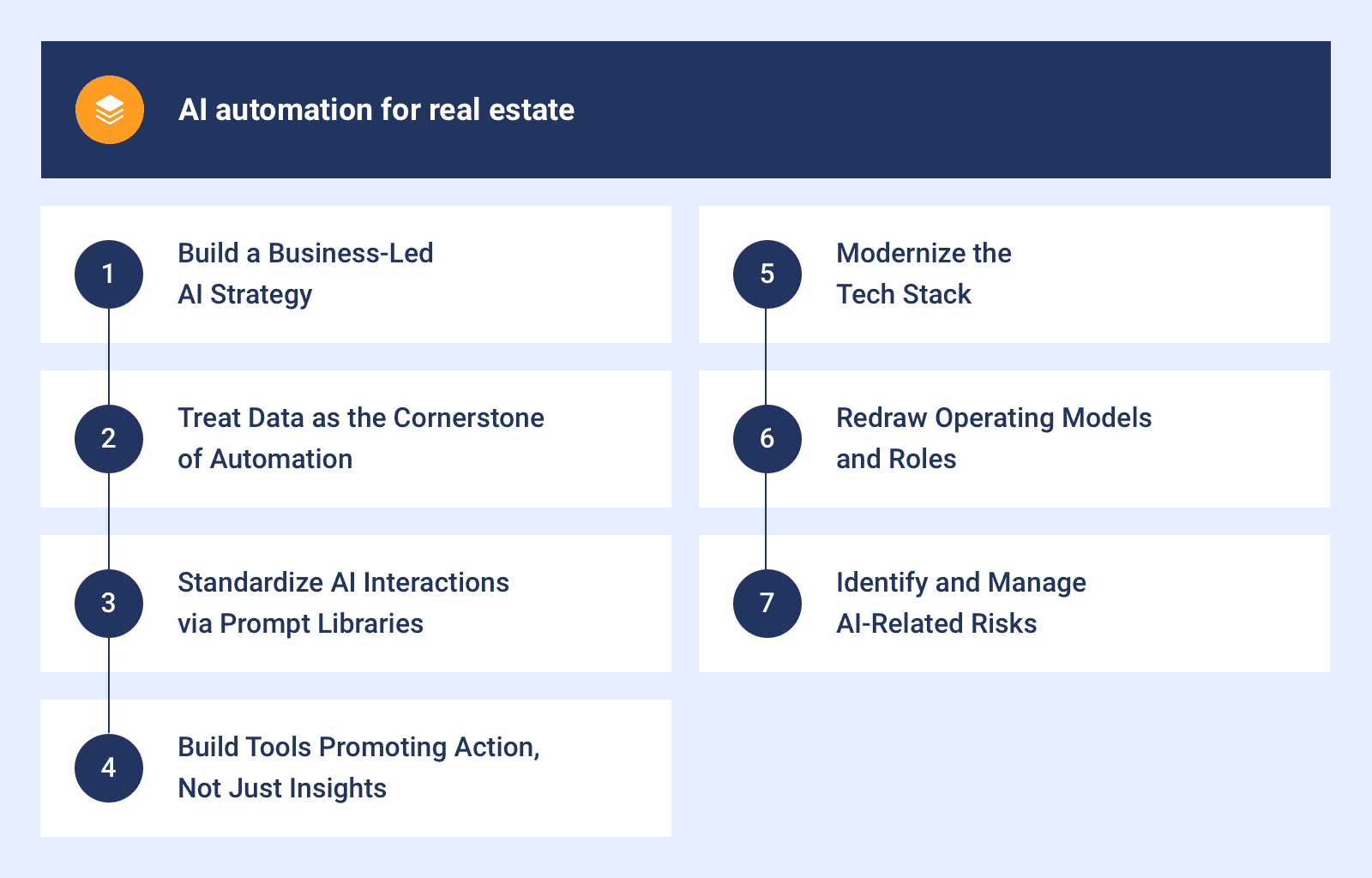
Let’s suppose you are actively considering implementing any of the discussed AI and machine learning applications in real estate. To handle the process smoothly, you require a strategy, structure, and solid foundation.
1. Build a Business-Led AI Strategy
AI implementation starts with leadership-level alignment. Executives must determine which part(s) of the real estate value chain AI is most impactful in. This may include development, investment, leasing, operations, or tenant experience. By clarifying this, CEOs can set priorities and test new strategies.
2. Treat Data as the Cornerstone of Automation
“Garbage in, garbage out” should become your guiding principle. It implies that the outputs of all AI systems, whether ML models or custom AI for property management, directly depend on the quality of the data they are fed. To succeed, consider the data you already have and the additional, unique data you could be capturing.
3. Standardize AI Interactions via Prompt Libraries
Whether using generative AI, forecasting models, or recommendation systems, consistency matters. Create reusable frameworks or prompt libraries to make sure your teams interact with models effectively and get reliable results.
4. Build Tools Promoting Action, Not Just Insights
It is astonishingly effortless to get insights from AI analysis, especially from that conducted by large language models. However, those insights may never translate into real decisions if you don’t have the right tools and workflows in place. To make the most out of AI-driven forecasts, pair your AI system with other apps, such as dashboards, automation triggers, and compliance checkers, depending on your specific needs.
5. Modernize the Tech Stack
A strong technical foundation is essential. First of all, it is the infrastructure that can store data securely, integrate with existing company software, and handle resource-intensive AI workloads. Secondly, this includes cloud platforms, monitoring systems, integrations, safeguards, and feedback loops.
6. Redraw Operating Models and Roles
Over time, AI for realtors will automate an increasing number of repetitive tasks, including tenant screening, leasing, document processing, and beyond. This means you will need to have your current employees switch to other, not yet automated tasks, or enroll in upskilling programs. You’ll also require such new roles as data engineers, AI, and automation specialists.
7. Identify and Manage AI-Related Risks
Despite the numerous benefits, AI-powered real estate data intelligence introduces new categories of risk. The most widespread ones are data quality issues, algorithmic bias, and concerns around privacy, compliance, and intellectual property. To avoid those, establish governance frameworks that continuously monitor model behavior and verify its outputs.
AI Tools for Real Estate Agents
Adopting AI technology for real estate is easier when you know which tools are available. And, in fact, there are plenty of solutions that cover various parts of real estate workflows, from customer interactions to marketing management.
Automated valuation models. Zillow Zestimate, Redfin Estimate, and CoreLogic’s Automated Valuation Model analyze market data and property attributes to come up with accurate value estimates.
AI-powered CRM systems. Salesforce, Lofty, CINC, kvCORE, and Rex Software are used for scoring leads and automating client interactions.
Virtual tour and staging software. Matterport, REimagineHome, Virtual Staging AI, and Getfloorplan generate virtual tours, 3D floor plans, and digital staging solutions.
Document automation tools. DocuSign, DocSumo, Cactus, Prophia, Bryckel AI, and Kolena AI draft, review, and verify contracts, disclosures, and other paperwork.
Content and marketing generators. ChatGPT, Placester, Epique, and Canva’s AI tools help create listing descriptions, email campaigns, and so on.
Data analytics platforms. Tableau AI, Polymer, HouseCanary, Reonomy, and Skyline AI forecast market trends and identify the most lucrative decisions.
The Future of Artificial Intelligence in Real Estate
AI will impact the real estate industry far beyond today’s personalization and advanced analytics. In the next few years, it will completely change how buildings are designed, how cities grow, and the way investors allocate capital. The most prominent trends are:
Shifting Real Estate Hotspots and Talent-Driven Markets
As AI becomes foundational in many industries, real estate demand will be largely influenced by the influx of AI talent. Cities with strong tech ecosystems (such as research universities, innovation hubs, and startup accelerators) will attract more AI companies, 37% of which are based in the US. This means more commercial real estate, including office spaces and labs, will be needed.
Growing Need for Infrastructure
Besides just office buildings, AI’s expansion means more data centers, energy grids, and connectivity infrastructure will be necessary. This will stimulate the development of new facilities and the retrofitting of older assets, creating opportunities for real estate investors and developers.
Emergence of AI-Ready Buildings
The rise of the “real intelligent buildings” is underway. AI-ready infrastructure will become as basic as an internet connection in today’s buildings. Future attributes of such facilities will include built-in sensor networks, robotics-friendly layouts, and automated building management systems.
Accelerated Investment and New Revenue Models
The use of AI in real estate investment promises faster due diligence and shorter transaction cycles. This will be possible due to quick, data-rich AI-enabled underwriting, property analysis, and risk assessment. These very features will also make global investment more transparent and accessible.
For landlords and developers, AI-ready spaces may open new revenue opportunities such as advanced “space-as-a-service” offerings, turnkey analytics platforms for tenants, or modular upgrades that connect directly to building AI systems.
Reconsidering Design and Space Functions
AI will have an immense influence on the design and overall experience of spaces. Thanks to advanced analytics capabilities, real estate developers will be able to study customer behavior, environmental conditions, and usage patterns, and, based on that, create spaces that adapt dynamically.
Final Thoughts
Let’s sum things up! AI is doing wonders for the world's businesses, and the real estate sector is no exception. Property owners, investors, dealers, and clients are equally benefitting from the smart decision-making powers of AI algorithms. From automated transactions to virtual property viewings, nothing is impossible in the age of the fully digitized real estate industry.
Leveraging Artificial Intelligence in the real estate industry will not only cut down on property management costs to half their original value but also gives you a competitive edge in the market. However, the risks of cyber-security pose a constant threat, and will only be solved with smart innovations. The key is to follow the legal regulations involving AI and maintain a vigilant watch on data security initiatives.
Are you ready to boost your Return on Investment (ROI) with advanced AI algorithms?
Feel free to take your business to the next level with Integrio IT services. Our team of AI software development specialists, with 20+ years in the industry, are here to digitize your real estate company.
FAQ
AI assists real estate agents by performing mundane tasks, including automatic property valuation, content generation, personalized property recommendations, and predictive maintenance. It also powers chatbots that manage initial client queries. All of these applications enhance the effectiveness of decision-making.
AI in real estate is the application of machine learning, computer vision, and predictive analytics technologies to streamline various aspects of the industry. It is used to determine property value and predict market trends, as well as to provide personalized customer experiences and more efficient building management. It transforms data into actionable information and improves the quality and speed of real estate services.
Real estate AI helps automate administrative tasks, analyze large datasets to generate market insights, and provide personalized customer advice. It can also create virtual tours, handle predictive maintenance, optimize property management, qualify leads, and perform real estate valuation using data mining software.
AI for real estate developers is used for property valuation (via predictive analytics), marketing (content creation via generative AI), and customer service (via recommendation engines, chatbots, virtual assistants). It is also applied in market trend forecasting, lease management, and lead nurturing.
AI is not going to replace real estate professionals entirely, but it will greatly transform the industry. Routine functions will be automated, while agents and brokers will handle higher-value tasks, including strategic direction, negotiations, complex transactions, and relationship-building.
The most commonly implemented form of AI in the real estate sector is machine learning and natural language processing. They essentially power such key services as property valuation, data analysis, customer support, and content generation.
Positively. AI will transform the real estate industry by simplifying workflows, improving valuation and prediction precision, and providing customers with increasingly tailored experiences. It will also automate tenant screening and lease prep, assist in investment decisions based on predictive market analytics, and facilitate immersive experiences such as virtual tours.
We use cookies and other tracking technologies to improve your browsing experience on our website. By browsing our website, you consent to our use of cookies and other tracking technologies.